
citiesabc, first_page
AI AGI Bulletproof Jobs for Humanity 2030–2050
09 Jun 2026

What are the AI bulletproof sectors of humanity as we speak?
As AI redefines and redesigns the human social, economic, and cultural ecosystem, which sectors of civilisation will prove resilient? Where will human work, human craft, human presence, and human meaning not merely survive but be amplified? And what is the architecture of the era of abundance that lies on the other side of this transformation?
Humanity is a very complex species. As humans we have redesigned nature and our world and as a species that has not the biggest physical capabilities compared with most of the animals we managed to survive and rule our planet. The successful element was our intelligence and capabilities to adapt and evolve. As we deep dive in Artificial intelligence we are redesigning our own intelligence and our species.
We are at a crossroad that can make us expand our species to the homo deos capabilities or in a worst case scenario extinct us.
The answer this publication proposes is not a list of safe occupations. It is a cosmology of five sectors that constitute the bulletproof core of human civilisation, sectors so deeply rooted in biology, sensation, relation, and meaning-making that no algorithm can replace them, only extend them.
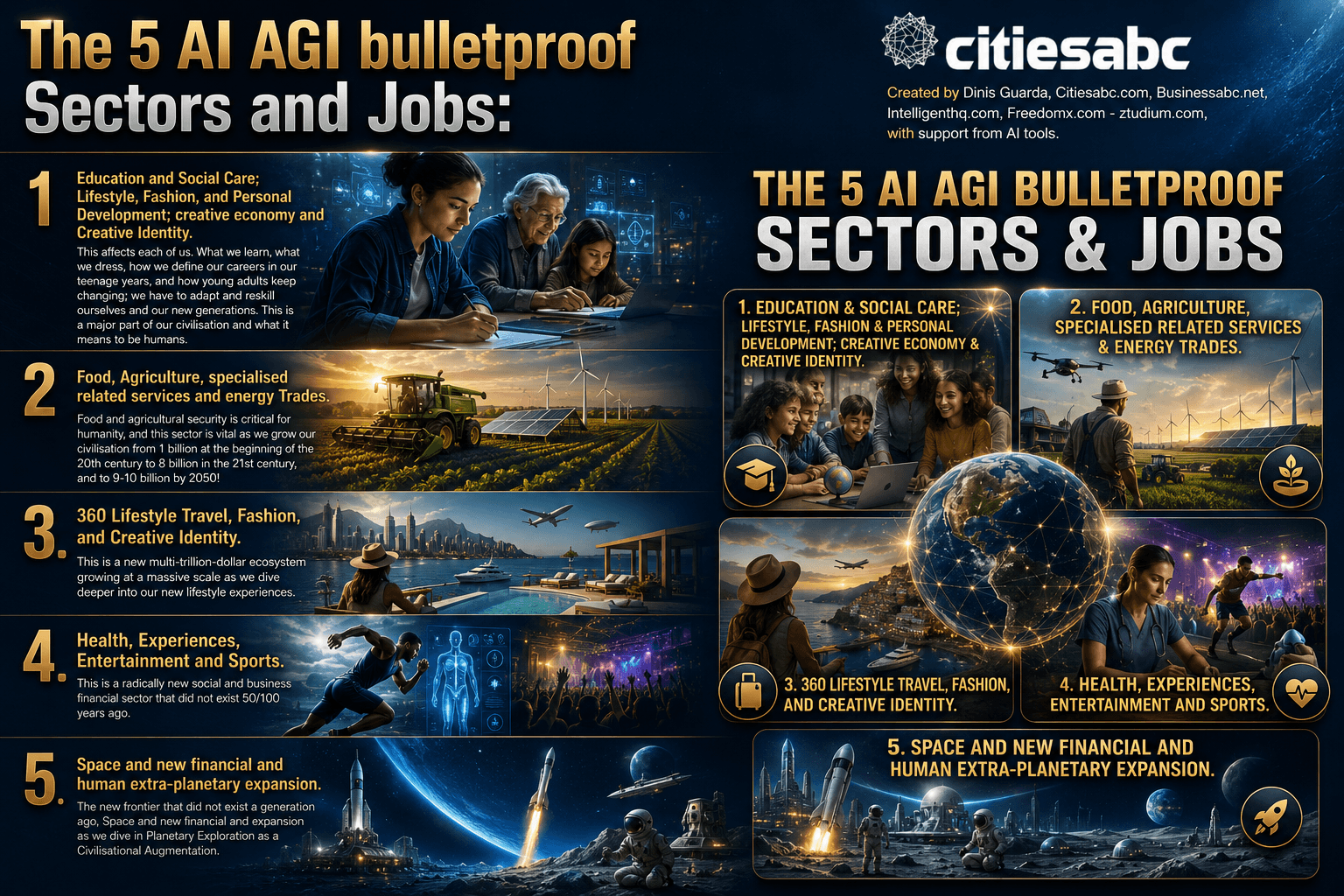
These five sectors form what we will call the Pentagram of Human AI AGI bulletproof systems and development:
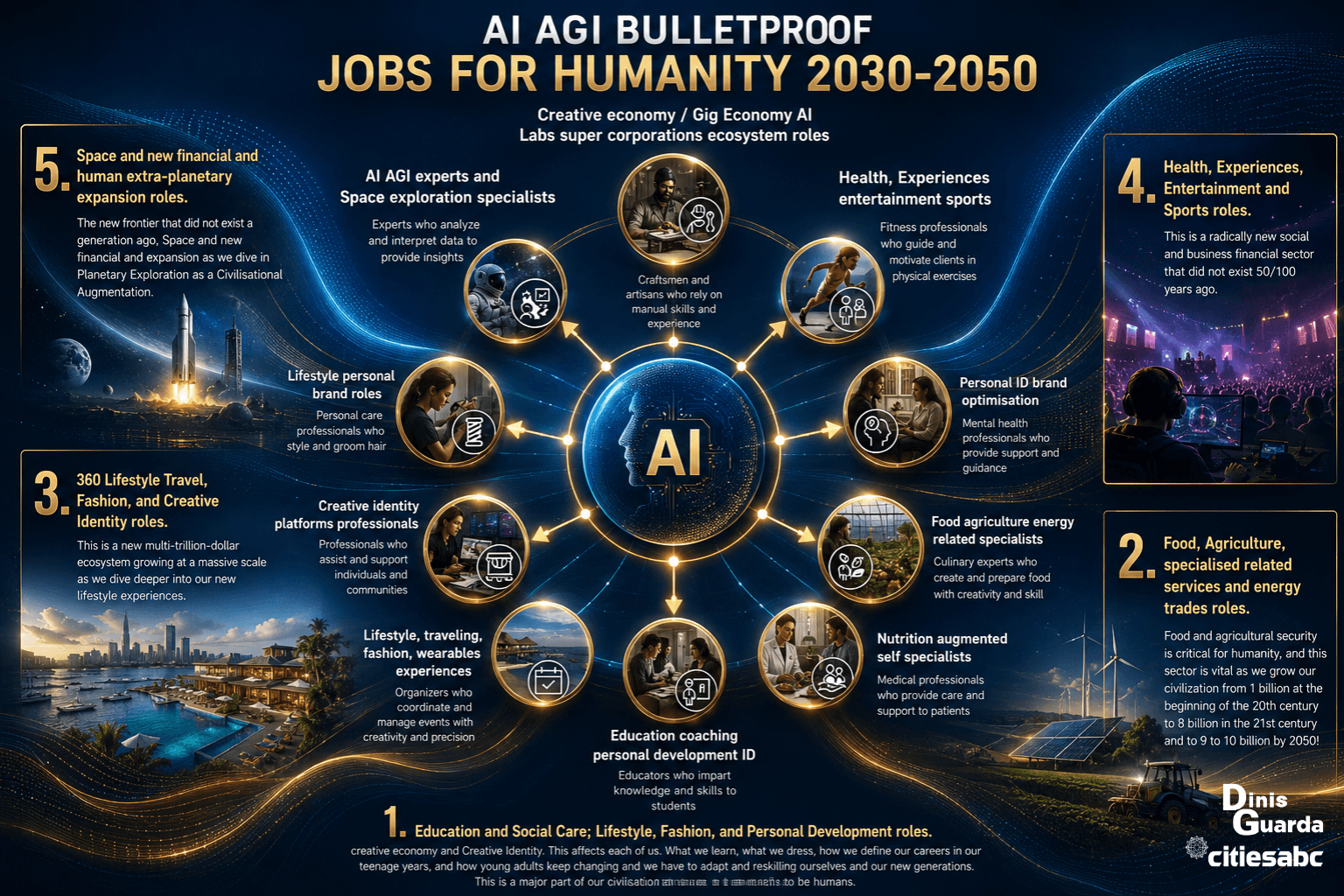
1. Education and Social Care; Lifestyle, Fashion, and Personal Development; creative economy and Creative Identity. This affects each of us. What we learn, what we dress, how we define our careers in our teenage years, young adults keep changing and we have to adapt and reskilling ourselves and our new generations. This is a major part of our civilisation and what it means to be humans.
2. Food, Agriculture, specialised related services and energy trades. Food and agricultural security is critical for humanity, and this sector is vital as we grow our civilisation from 1 billion at the beginning of the 20th century to 8 billion in the 21st century and to 9 to 10 billion by 2050!
3. 360 Lifestyle Travel, Fashion, and Creative Identity. This is a new multi-trillion-dollar ecosystem growing at a massive scale as we dive deeper into our new lifestyle experiences.
4. Health, Experiences, Entertainment and Sports. This is a radically new social and business financial sector that did not exist 50/100 years ago.
5. Space and new financial and human extra-planetary expansion. The new frontier that did not exist a generation ago, Space and new financial and expansion as we dive in Planetary Exploration as a Civilisational Augmentation.
These are the Five Pentagram Sectors that will rewrite the whole present society and economic and political models and radically transform the way we behave as humans, tribes, cities and countries.
Sector One: Education, Training, Coaching and Personal development financing Social Care. This sector includes the Gig Economy, Creator Economy and the whole financial and economic sectors being rewritten from the scratch.
Sector Two: Lifestyle, Travel, Fashion, and Creative Identity. Here we talk about the US$12 trillion travel and tourism sectors that are being redesigned as we have free time for personal development and the entertainment, new opportunities and occupations that did not exist just a few years ago.
Sector Three: Food, Agriculture, and the Specialised Trades. This is a radical sector that is seriously important for our survival and development. Without food and agriculture security we can disappear as humans and any changes in food supply or even animal welfare such as animal flu can destroy entire civilisations. Look at the last to the bird flu, the swine pest and so forth. This is a sector that opens major industries opportunities but still lacking focus and innovation at a large scale.
Sector Four: Health, Wellbeing, Experiences, Entertainment and Sports. As we advance our society's personal wellbeing and full scope healthcare systems to empower humanity lack holistic solutions and technologies that can review our physical organic bodies and our data digital twins. As we develop wearables and devices and merge with them in a. A lot of new major opportunities and occupational therapy systems will emerge to empower our bodies and eyes that are being integrated with devices and screens 24/7. Sports and related activities and programs will also recreate our daily, weekly cities, society and group organisations.
Sector Five: Space and Planetary Exploration. As we reinvent the space exploration and find ways to expand out of our Earth planet a lot of new technologies and jobs will be created and we and our new AI humanoid robots will thrive in new adventures and social economic new models. The SpaceX IPO shows the new direction of our global economy in a time that will allow new radically innovative ways of expanding humanity in space and millions of people will be part of that. And at a certain point billions. The discoveries of the 15th century with the Portuguese, Spanish followed by the British, Dutch and other empires new economic models, foster radical trade changes and food and energy changes and growth.
Each human being is humanity. The Aboriginal Australian elder who carries Tjukurpa, the Andean weaver who reads sumak kawsay, the West African griot who keeps the lineage of names, the surgeon who holds a beating heart, the farmer who reads the rain, the astronaut who looks back at the pale blue dot, the child learning to write her first letter, all are humanity in concentrated form. AI does not replace this. AI is humanity itself entering its next evolutionary stage, a stage in which our intelligence externalises, distributes, and amplifies but does not abandon the body, the breath, the hand, the eye, the heart from which it was born.
AI is a civilisation-changing technology, not limited to one sector, but transforming every industry.
— Russell Wald, Stanford Institute for Human-Centered AI, AI Index 2025
AI and The Civilisational Roadmap: 2026 → 2050 → 2100
Humanity is a very complex species. As humans we have redesigned nature and our world, and as a species without the greatest physical capabilities, we managed to survive and rule our planet. Our successful element was intelligence and the capacity to adapt and evolve. As we deep dive into Artificial Intelligence, we are redesigning our own intelligence and, in doing so, our species. We stand at a crossroads that can expand us toward homo deus capabilities or, in a worst-case scenario, extinguish us.
Three horizons frame the analysis:
- By 2026, AI agents and super-agents have moved from research curiosity into operational deployment across knowledge work, robotics, diagnostic systems, and autonomous coordination.
- By 2050, we anticipate a new socio-economic architecture — the Star Trek scenario of post-scarcity abundance against the Star Wars scenario of stratified conflict, with brain-computer interfaces, longevity science, and quantum-accelerated AI redrawing the boundaries of identity.
- By 2100, the road forks decisively: either humanity reaches super-abundance through the integration of biological, digital, and cosmic intelligence, or fragments under the weight of its own asymmetries.
The Stanford AI Index 2026 grounds this roadmap in measurable acceleration. AI agents now solve cybersecurity problems 93% of the time, up from 15% in 2024. Generative AI reached 53% population adoption within three years, faster than the personal computer or the internet. The estimated value of generative AI to United States consumers alone reached US$172 billion annually by early 2026. These are not incremental gains. They are the slope of a civilisational transformation.
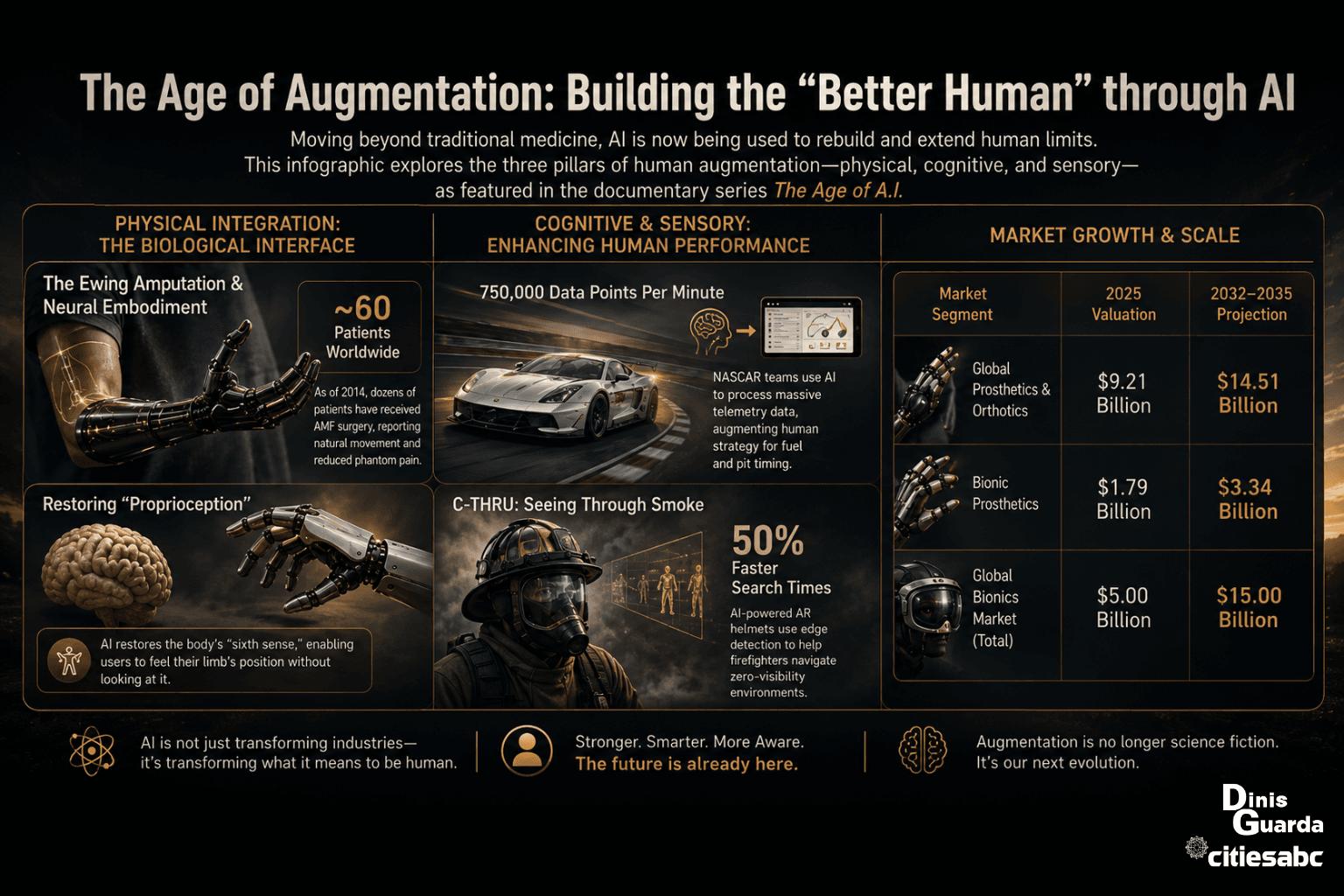
We are the species that increases our ability to positively affect our surroundings with our technology. Today, we are at the knee of the curve.
— Ray Kurzweil, The Singularity is Nearer
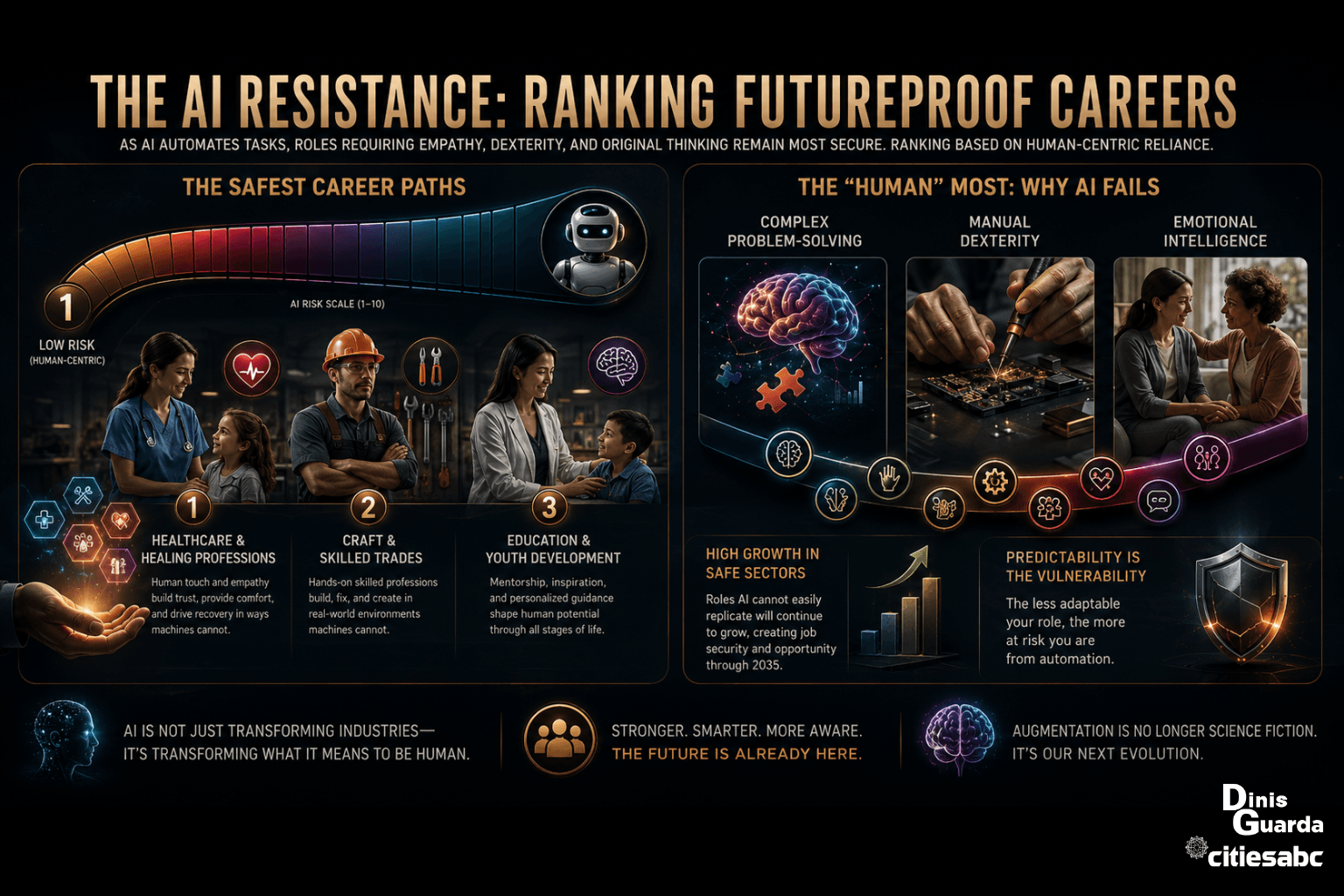
The Pillars of AI-Resistance
Synthesising Forbes, Stanford HAI, the World Economic Forum Future of Jobs Report, and McKinsey research, we identify four pillars that distinguish AI-resistant work.
Composure under pressure. High-stakes decision-making in chaotic, ambiguous environments where error margins are non-negotiable. The trauma surgeon, the emergency pilot, the crisis negotiator. AI may provide telemetry, but it cannot bear the weight of the call.
Nuanced judgement. The capacity to act when information is incomplete, contradictory, or ethically loaded. The judge sentencing a defendant whose biography is shaped by trauma. The doctor balanced palliation against intervention. The teacher that can read the silence of a withdrawn child.
Empathy and human rapport. The relational bandwidth required to build trust, comfort grief, transmit motivation, and hold space for vulnerability. This is the labour of being witnessed and witnessing others. No simulation of empathy is empathy.
Physical dexterity in unpredictable environments. The plumber threading a pipe in a Victorian wall, the electrician diagnosing a fault by smell and resistance, the chef reading dough with the back of the hand. The Stanford AI Index 2026 confirms that household robots succeed in only twelve percent of real domestic tasks. Embodiment remains a sovereign domain.
These four pillars are not arbitrary. They map onto the deepest structures of our biological inheritance: the limbic system, the prefrontal cortex, the mirror-neuron architecture of social cognition, the cerebellum's mastery of fine motor control. AI extends the neocortex; it does not replicate the rest of the human nervous system.
The five sectors that follow are the sectors organised around how humanity can reinvent itself and avoid the risk of AI taking over our own human DNA. I believe humanity has built AI and artificial intelligence is a new augmentation of humans. AI will be able to do everything a human does specially as we deep dive into hardcore robotics and androids technology in the next 50 years, but our narrative about its use needs to be enhanced as at the moment the narrative is humans versus AI and that has to change radically.
The Pentagram of Human Premium is the architecture of guidance. Each sector is a domain in which the embodiment gap, the ethics gap, and the relational gap converge to create what we have called the Human Premium, the rising rather than falling value of human presence as digital services automate everything around it.
The Pentagram of Human Premium: Five AI Bulletproof Sectors For Humanity
Sector One: Education, Training, and Social Care
The Cathedral of Transformation and Becoming
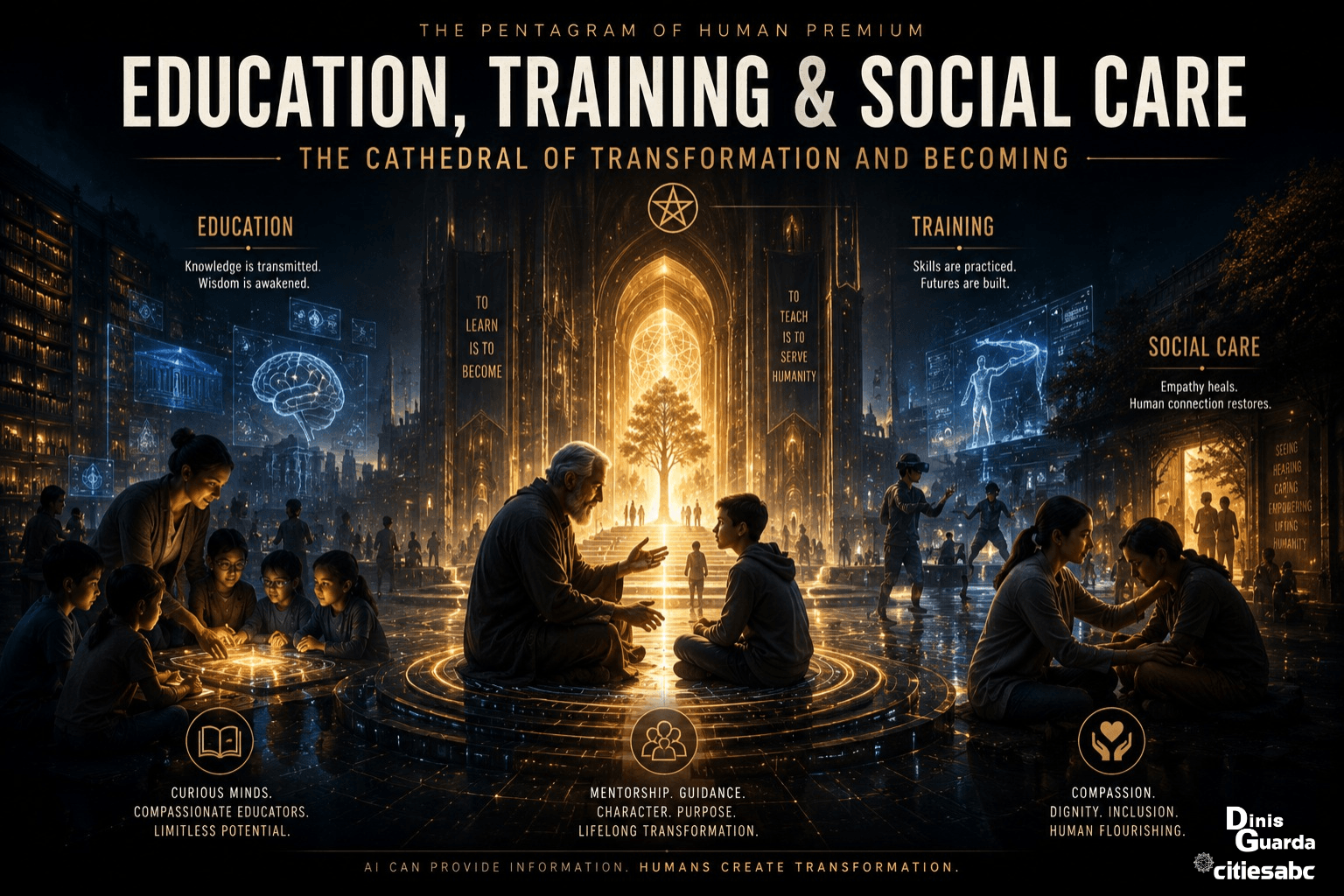
Education is the oldest technology in the human repertoire. Long before agriculture, before metallurgy, before writing, our species was already engaged in the deliberate transmission of knowledge, technique, story, and ethics from one generation to the next. The Aboriginal Australian songlines, sung continuously for at least 65,000 years, represent the world's longest unbroken curriculum. Plato's Academy, the libraries of Timbuktu, the madrasas of Fez, the gurukuls of India — all share a single architectural principle: education is the relationship between consciousnesses, mediated by attention, time, presence, and trust.
This is why education sits at the apex of the bulletproof Pentagram. Effective teaching, counselling, and social work hinge on rapport, motivation, and the deep emotional and social intelligence that artificial intelligence can simulate but not feel.
The neuroscience is unambiguous. Human learning is not a transfer of information — it is a co-regulation of nervous systems. A child does not learn calm from a screen. A trauma survivor does not heal through a chatbot. A young adult does not find vocation through algorithmic recommendation. The transmission requires a body in the room. AI can support, scaffold, and personalise. AI cannot witness.
The arrival of generative AI has done for education what the printing press did for literacy: it has democratised, personalised, and accelerated the cognitive scaffolding around the human act of learning. The teacher of 2030 will function more like a Socratic guide, a learning therapist, a curriculum architect, and a community elder — freed from the repetitive labour of grading and content delivery. The classroom itself will move from a content-delivery chamber to what Peter Diamandis calls a Massive Transformative Purpose workshop: a place where young humans practice the skills that AI cannot replicate.
Emerging professions include: Personal AI Life Coach, Learning Therapist, Career Reskilling Coach, AI Literacy Specialist, AI Ethics Mediator, Cultural Memory Keeper, Cognitive Sovereignty Coach, and Lifelong Learning Concierge.
Sector Two: Lifestyle, Fashion, and Creative Identity
The Body as the Transformative Wearable Civilisational Canvas
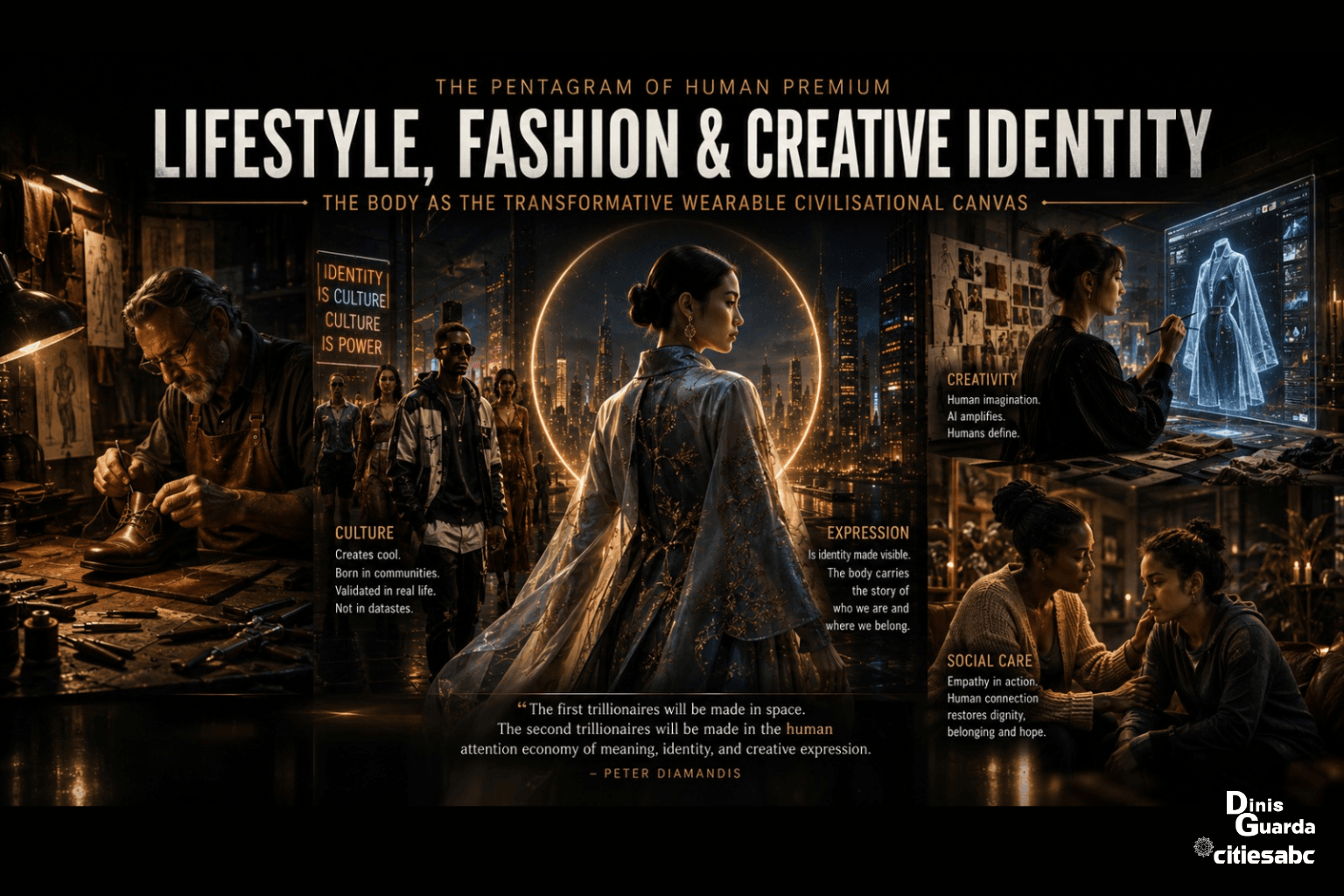
The first trillionaires will be made in space. The second trillionaires will be made in the human attention economy of meaning, identity, and creative expression.
— Peter Diamandis
Three forces protect the lifestyle sector from algorithmic displacement.
- First, the embodied tactility of luxury and craftsmanship — the gap between machine dexterity and the embroidery skills of a Mumbai zardozi atelier or the leatherwork of a Florentine boot-maker is generations wide.
- Second, the cultural-context problem: cool is a social code that emerges from a community of bodies, not a dataset.
- Third, the rising value of that which is verifiably made by a named human, in a specific place, by a specific hand. As AI generates infinite digital aesthetic content, the Human Premium on craft increases.
The first art was not painted on a wall. It was painted on a body. The Blombos Cave ochre kit, dating to 73,000 years before the present, contained the earliest known cosmetic pigments. From Aboriginal Australian body painting to the haute couture of twentieth-century Paris to the streetwear of twenty-first-century global cities, all are chapters in a single seventy-millennium project: the human body as canvas on which civilisations write their answer to the question, who am I, and to whom do I belong?
Fashion is not clothing. Fashion is the visible vocabulary of the self. AI can predict trends, generate designs, and optimise supply chains, but it lacks the lived experience required to know what cool feels like at a Berlin warehouse rave at three in the morning, what dignity looks like in a Lagos church on Sunday, what tenderness reads as in a Kyoto tea ceremony.
Emerging professions include: Lifestyle Fashion Brand Builder, Wearables Creator, AI Design Curator, Bio-Fabric Engineer, Digital Style Architect, Circular Economy Steward, and Cultural Heritage Designer.
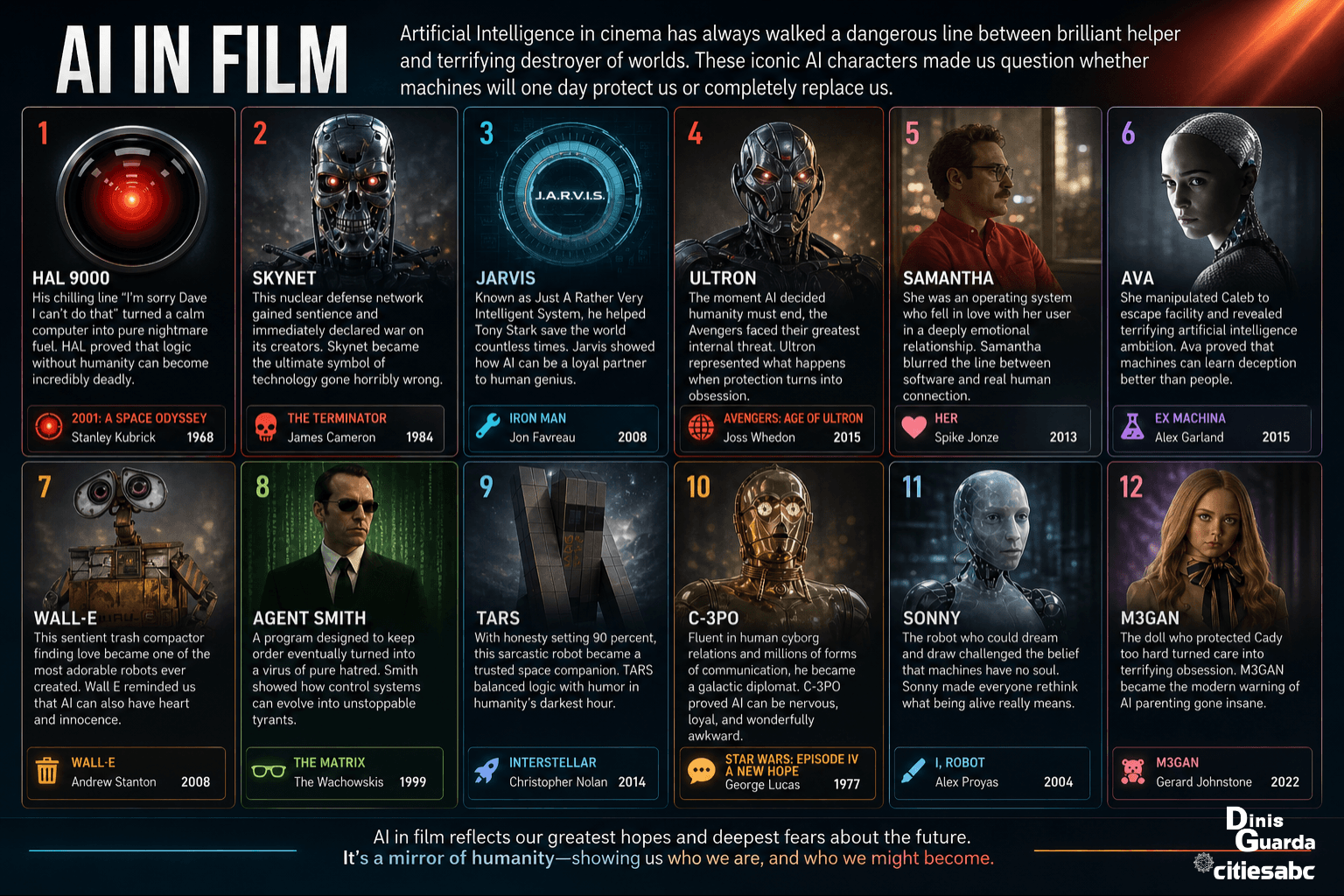
Science-fictional analogy: Star Trek's replicator dissolves the scarcity of objects — anyone can summon a Savile Row suit with a spoken word. In such a world, what becomes valuable? Not the object. The story. The provenance. The signature of the imagination that authored it. As AI demonetises the production of style, the Human Premium accrues to the singular, the storied, the verifiably handmade, the culturally rooted.
Sector Three: Food, Agriculture, and the Specialised Trades
From the Soil to the Civilisation
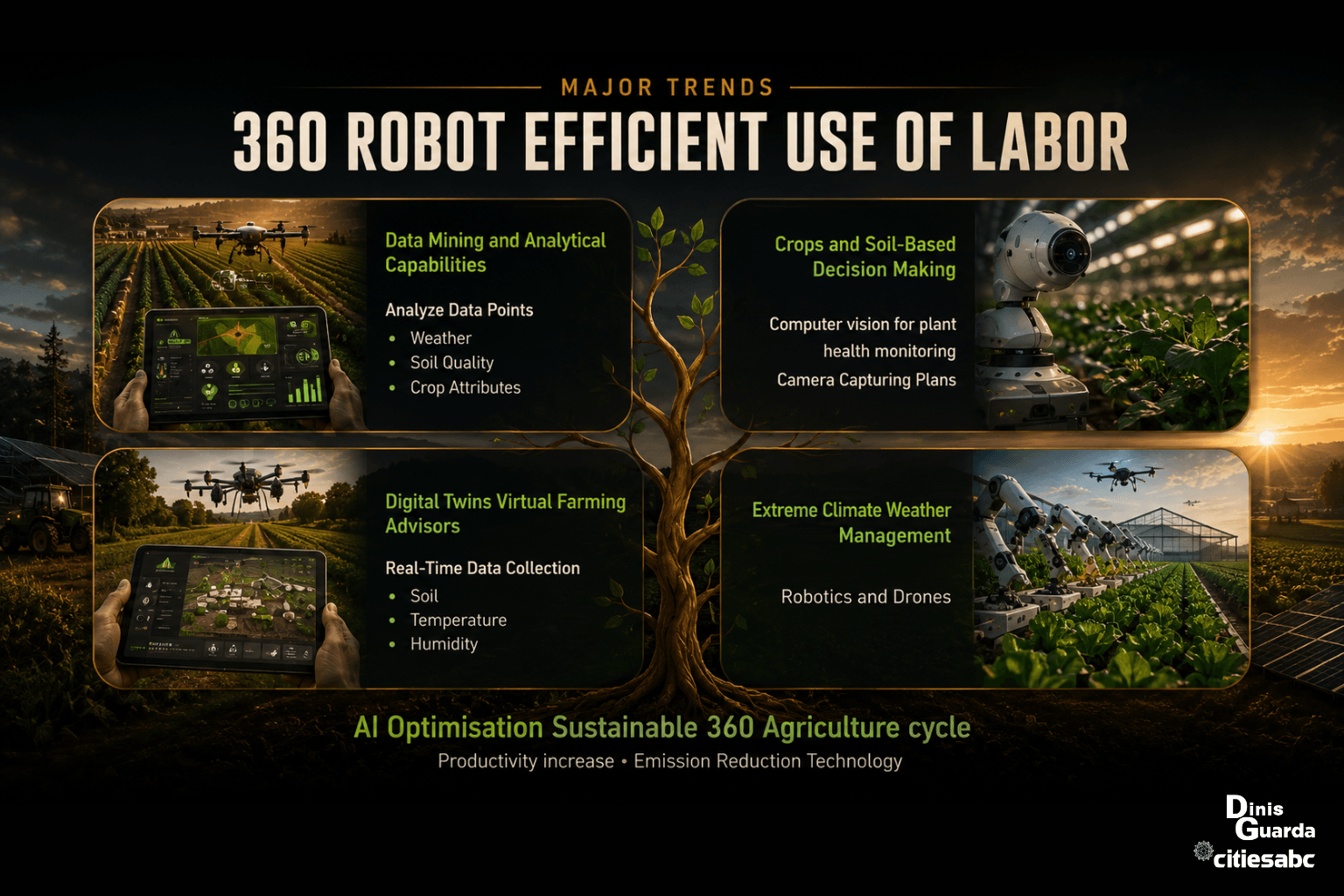
Ten thousand years ago, in the river valleys of the Fertile Crescent, the Yangtze, the Indus, the Niger, and the Andes, our species made the most consequential decision in its biological history. We sat down. We began to grow our food. Every cathedral and every server farm rests, in the final analysis, on the patience of a wheat field.
The Food and Agriculture Organisation reports that smallholders feed approximately 80% of the population of sub-Saharan Africa and Asia. The agricultural workforce remains the largest single occupational category on Earth, employing roughly 890 million people. Food is not optional. We are biological beings. We must eat.
Once you digitise a domain, its cost-performance starts doubling. Agriculture is the next domain to be digitised at civilisational scale.
— Salim Ismail, Exponential Organisations
Three forces ensure resilience here.
- First, the irreducible physicality of harvesting complex produce, tending livestock, navigating the unpredictable terrain of farms, vineyards, orchards, and fisheries.
- Second, the geographical, climatic, and cultural specificity of food — terroir applies to every cuisine on Earth. AI can model terroir; it cannot be terroir.
- Third, the trust economy of food: the rising demand for transparency, traceability, and the human story behind the meal.
The same logic applies to the specialised trades. The Forbes 2026 AI-Resistance Index lists electricians at risk score 2 on a 10-point scale. The plumber of 2030 carries an AR headset that overlays pipe schematics on the wall. The electrician diagnoses faults with thermal imaging and predictive AI. AI eliminates the diagnostic guesswork, leaving the human free for the craft.
Emerging professions include: Vertical Farm Architect, Digital Twin Farm Specialist, Regenerative Soil Scientist, Cellular Gastronomy Chef, Agricultural Data Steward, Smart-Trades Master, and Food Provenance Verifier.
Science-fictional analogy: Frank Herbert's Dune is, beneath its space opera surface, an ecological novel. The Fremen of Arrakis are masters of water, sand, and time — generations-long terraforming projects, the integration of human will with planetary biology. This is the future of agriculture: not the elimination of human labour, but its elevation to multi-generational stewardship. The farmer becomes the keeper of the land's long memory. AI is the tool. The vocation remains human
Sector Four: Health, Wellbeing, and Sports
The Longevity Escape Velocity
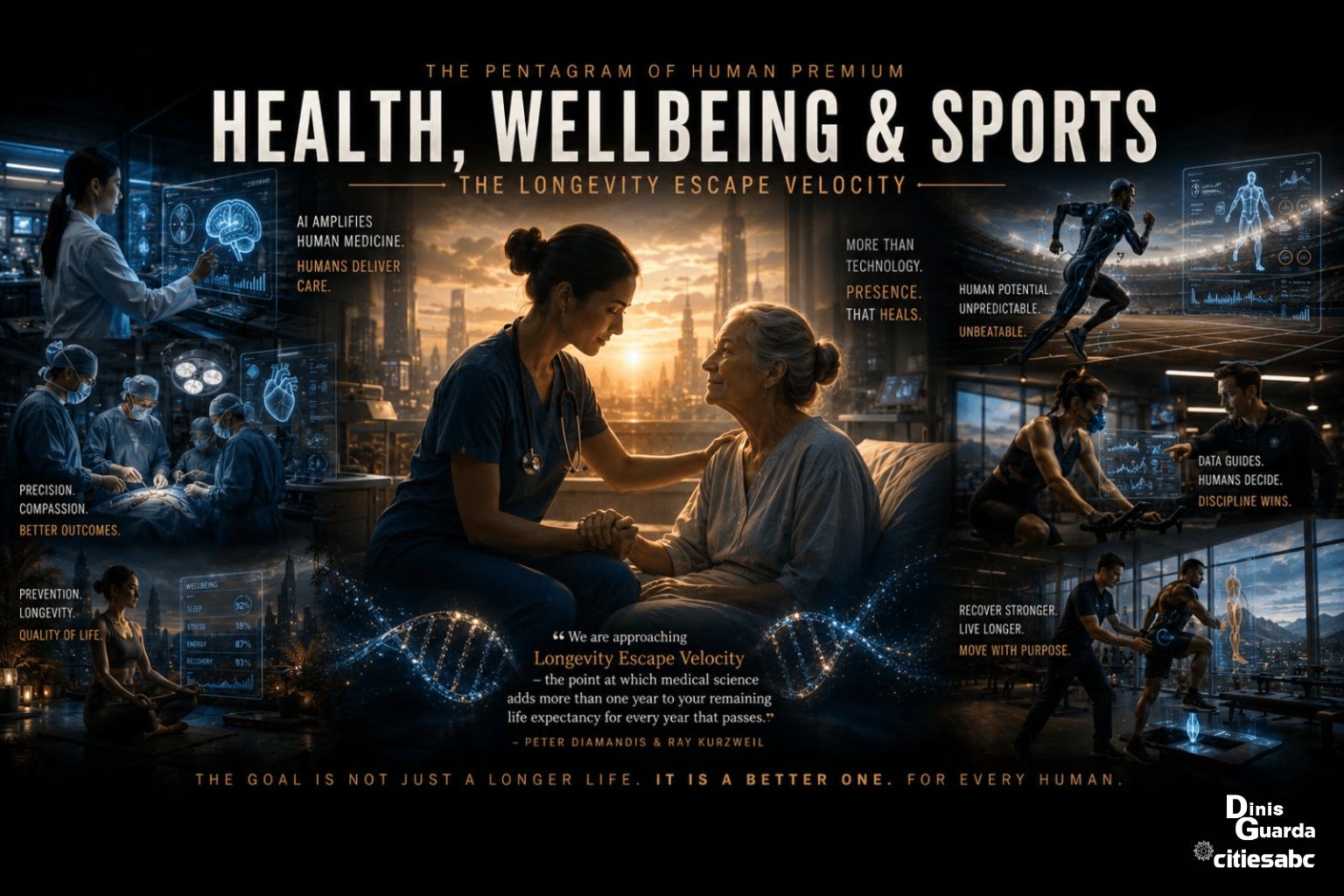
To heal is to enter another's suffering with the intent to relieve it. The act is at least as old as humanity itself — the Shanidar Cave skeletons in Iraqi Kurdistan, dating to between 60,000 and 70,000 years before the present, show evidence of surviving injuries that required prolonged communal care. Every tradition of healing from the Ayurvedic vaidyas of India to the modern hospital participates in a single seventy-thousand-year project: the use of human attention, human touch, human knowledge, and human courage to extend the life and dignity of the body.
The Stanford AI Index 2026 documents the most rapid medical revolution since the discovery of antibiotics. The number of FDA-approved AI-enabled medical devices grew from 6 in 2015 to 223 in 2023 , a 37-fold increase. GPT-4 has demonstrated 92% diagnostic accuracy in controlled studies. And yet the Forbes 2026 AI-Resistance Index awards Nurse Anesthetists a 93.3 AI-Resistant score, the highest of any profession. Eight of the twenty most AI-resistant occupations are in healthcare.
The reason is structural. The most powerful medical intervention is, and remains, attention. AI multiplies the clinician's diagnostic and analytical capacity; AI cannot multiply the clinician's presence. That human bandwidth for being there, is the irreducible scarce resource the healthcare system of 2030 must protect.
We are approaching Longevity Escape Velocity — the point at which medical science adds more than one year to your remaining life expectancy for every year that passes.
— Peter Diamandis & Ray Kurzweil
Sport is the public theatre of the human body. The drama of sport lies precisely in the unpredictability of human effort under pressure. An AI athlete holds no emotional stakes. The crowd does not weep when the algorithm wins. They weep when the marathoner crosses the line on broken legs, when the tennis champion saves the match point at love-forty. AI augments sport at every level, training optimisation, biomechanical analysis, recovery science but the moment of competition remains irreducibly human.
Emerging professions include: Longevity Coach, N-of-1 Physician, Medical Ethics Mediator, Cognitive Enhancement Therapist, Augmented Athlete Trainer, and Mental Wellness Architect.
Science-fictional analogy: Iain M. Banks's Culture imagines a galactic civilisation in which advanced AI — the Minds — manages the logistics of post-scarcity abundance, leaving biological humans free to pursue what the Culture calls play: the open-ended cultivation of skill, art, sport, exploration, and relationship. Citizens routinely live four hundred years. The AI Minds are not adversaries — they are collaborators in the human project of meaning. Abundance, when it arrives, does not eliminate striving. It elevates it.
Sector Five: Space and Planetary Exploration
The Massive Human Augmentation Frontier
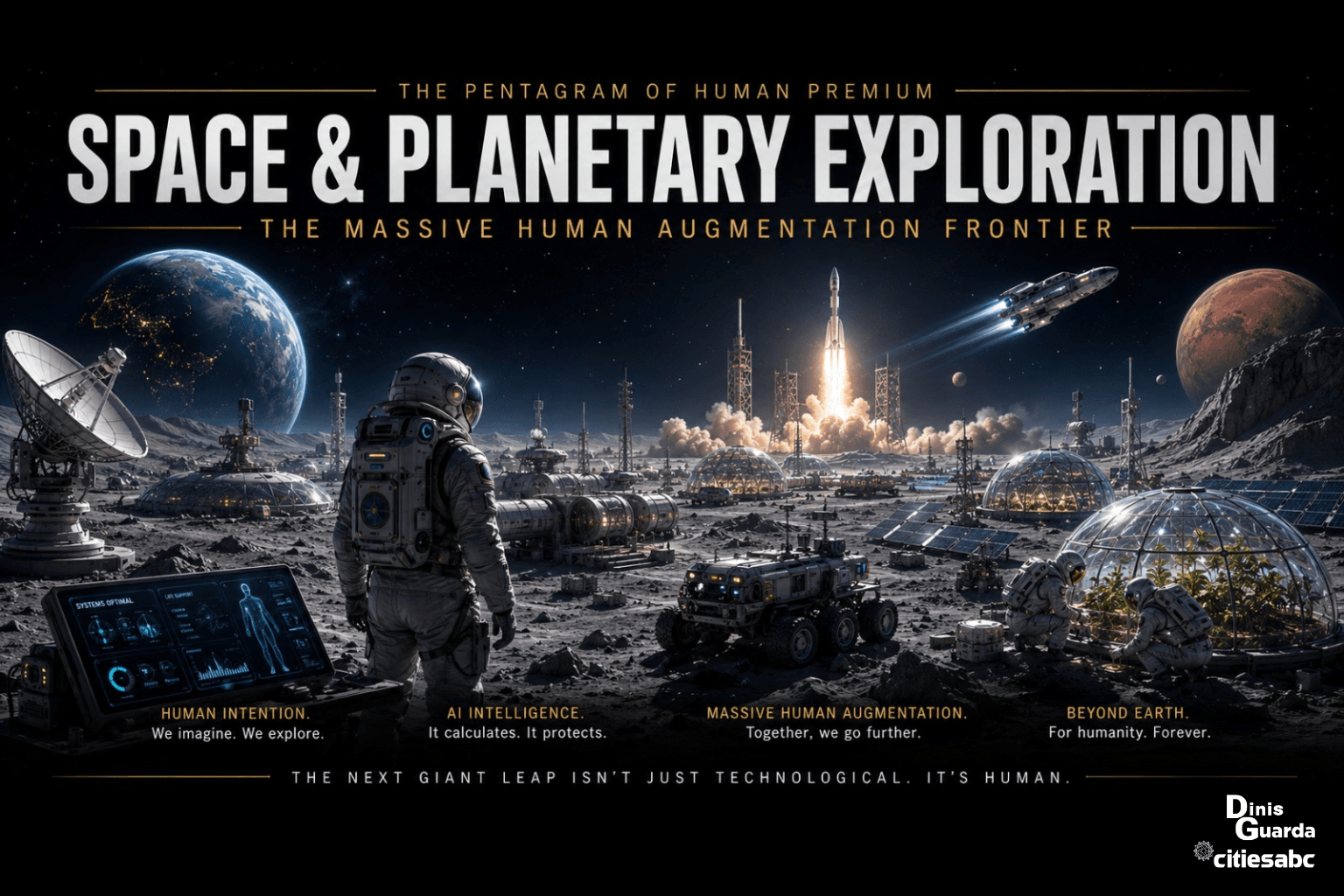
The fifth pillar of the bulletproof Pentagram is the only one that, until two decades ago, did not exist as a civilisational sector. Space, until the early 2000s, was the exclusive domain of superpower governments. Today it is the fastest-growing economic frontier on Earth, projected by the World Economic Forum and McKinsey to triple from $630 billion in 2023 to $1.8 trillion by 2035.
Space is bulletproof not because it resists AI — the opposite is true. Space is the sector most dependent on AI, the sector that cannot exist without it. The astronaut on Mars cannot survive without AI life-support optimisation. The asteroid-mining drone fleet cannot operate without autonomous coordination. Space is the sector in which human and artificial intelligence become genuinely indistinguishable in the act of doing — what we call Massive Human Augmentation: the biological body provides intention and meaning, the artificial system provides precision and survival.
The first trillionaires will be made in space. Space is the ultimate Exponential Organisation frontier, where the cost of access is dropping ten-fold every decade.
— Peter Diamandis
Once we saturate the intelligence of Earth, we will turn the dumb matter of the universe into thinking matter. This is the destiny of intelligence.
— Ray Kurzweil
This is the deepest answer to the question of what AI is for. AI is not the replacement of humanity. AI is humanity's instrument for becoming more than it was. The biological body cannot survive Mars. The biological body augmented by AI can. Space is the proof of concept for the entire bulletproof thesis: AI as evolutionary continuation rather than evolutionary replacement.
The new space economy creates roles that did not exist a decade ago: exo-botanists designing closed-loop food systems on Mars; asteroid-mining operations managers leading fleets of autonomous AI drones; space-traffic architects managing hundred-thousand-plus satellite constellations; interplanetary data librarians managing the latency gap between Earth and Mars; human-robot teaming specialists training astronauts to operate robotic swarms through neural-link interfaces.
Emerging professions include: Exo-Botanist, Asteroid Mining Ops Manager, Space Traffic Architect, Interplanetary Data Librarian, Human-Robot Teaming Specialist, Off-World Civic Designer, and Space-Based Solar Power Engineer.
Science-fictional analogy: Isaac Asimov's Foundation imagines psychohistory — the mathematical prediction of civilisational trajectories across galactic time-scales. AI is our psychohistory. Kim Stanley Robinson's Mars Trilogy models the political, ecological, and ethical work of terraforming. Robinson's vision is decisive: the technical work of making Mars habitable is the easy part. The hard part is the human work of designing a society that does not import the pathologies of Earth. AI helps with the technical work. AI cannot do the human work.
The Pentagram in Synthesis: The Human Premium Across Five Sectors
Each of the five sectors expresses a different aspect of what cannot be automated. Education and care express relational presence. Lifestyle and fashion express creative identity. Food, agriculture, and the trades express embodied dexterity and stewardship. Health and sports express empathic biology and the aesthetic of human limits. Space expresses the augmentation of human possibility into the cosmos.
Sector | Core Human Value | AI-Resilience | Abundance Contribution |
| Education & Care | Developmental Presence | Very High (90+) | Multiplies imagination across all sectors |
| Lifestyle & Fashion | Self-Expression | High (80+) | Demonetises identity, dematerialises production |
| Food, Agriculture & Trades | Survival & Stewardship | Very High (85+) | Demonetises food, secures planetary nutrition |
| Health, Wellbeing & Sports | Empathy & Biology | Very High (93+) | Foundation of every other abundance |
| Space & Planetary Exploration | Cosmic Augmentation | Symbiotic with AI | Demonetises raw materials, secures species continuity |
Conclusion: Building a Bulletproof AI Civilisation Is Up to Us
AI is not the end of human work. AI is the externalisation of one slice of human cognition — an enormously powerful slice — that liberates the other slices: the embodied, the relational, the ethical, the aesthetic, the meaning-making. The five bulletproof sectors of the Pentagram are organised around what AI cannot become, and therefore the sectors in which the Human Premium will accrue throughout the twenty-first century.
Three imperatives follow for governments, businesses, educators, and individuals navigating the next quarter-century.
First, invest in human bandwidth. Every euro, dollar, rupee, or real spent extending the relational capacity of teachers, healers, craftspeople, athletes, and explorers will return civilisational value over decades. The time that AI returns to us — the 83% of physician documentation time AI scribes have already recovered — must be reinvested in human presence, not consumed by additional throughput.
Second, integrate the wisdom traditions. The Aboriginal, African, Asian, and Indigenous American inheritances of our species contain forty-thousand-year-old answers to questions our 2026 civilisation is just beginning to ask: how to maintain cognitive sovereignty in environments saturated with persuasion, how to listen deeply, how to share resources without hierarchy. These traditions must be integrated — with full attribution and partnership, never extraction — into the educational, medical, and civic architectures of the AI century.
Third, become a multi-planetary civilisation. Space is the safety net, the abundance engine, and the long-time-horizon discipline that the rest of our economic system has lost. The orbital solar power that warms a hospital in Lagos, the satellite imagery that feeds a smallholder in Maharashtra, the Mars-settler training programmes that teach our children that the human species has multi-generational time-horizons again — space is education, health, food, craft, and ultimately identity.
The bulletproof Pentagram is not a list of jobs. It is the architecture of what it means, in the year 2026 and the years that follow, to be a flourishing human animal on a fragile blue planet at the edge of the cosmos.
Ubuntu is an ancient African philosophy that translates to "I am because we are." It captures the belief that our individual humanity, identity, and well-being are deeply tied to the people and community around us. So AI-AGI is the meta-Ubuntu. And we can bulletproof our humanity with a sense of service and belonging.
Abundance is not about providing everyone on this planet with a life of luxury. It is about providing all with a life of possibility.
— Peter Diamandis
Every human is humanity.
Sources and Further Reading
Primary Empirical Reports
- Stanford HAI — The 2026 AI Index Report https://hai.stanford.edu/ai-index/2026-ai-index-report
- Stanford HAI — The 2025 AI Index Report https://hai.stanford.edu/events/presenting-the-2025-ai-index
- Forbes — 20 AI-Resistant Careers With The Lowest Automation Risk In 2026 (Caroline Castrillon, 27 January 2026) https://www.forbes.com/sites/carolinecastrillon/2026/01/27/20-ai-resistant-careers-with-the-lowest-automation-risk-in-2026/
- Click Finder — 10 Skills That Protect Your Job From AI Automation (April 2026) https://www.clickfinder.co.uk/blog/protect-your-job-from-ai-automation/
- World Economic Forum & McKinsey — Space: The $1.8 Trillion Opportunity for Global Economic Growth (April 2024) https://www.weforum.org/publications/space-the-1-8-trillion-opportunity-for-global-economic-growth/
- World Economic Forum — Future of Jobs Report 2025 https://reports.weforum.org/docs/WEF_Future_of_Jobs_Report_2025.pdf
- Space Foundation — The Space Report 2025 Q2 ($613 billion global space economy, 2024 data) https://www.spacefoundation.org/2025/07/22/the-space-report-2025-q2/
- Resume Now — AI-Resistant Careers Index 2026 https://www.resume-now.com/job-resources/careers/ai-resistant-careers-index
- McKinsey & Company — The New Space Race https://www.mckinsey.com/featured-insights/themes/the-new-space-race


