
innovation, resources, first_page
The Foundational Shift and Radical Changes in Construction and Real Estate

The $326 trillion real estate industry is at a breaking point. AI, blockchain, and PropTech aren’t just trends, they’re rewriting the rules. Companies clinging to outdated methods face extinction. Want to future-proof your business? How tech is slashing costs, boosting transparency, and unlocking unprecedented ROI? The revolution isn’t coming anymore, it is already here. Will you lead this revolution or get left behind?
 The Foundational Shift and Radical Changes in Construction and Real Estate
“The best investment on earth is earth.” — Louis Glickman
Change is never easy, especially in industries as deeply rooted in tradition as construction and real estate. As Machiavelli once observed, transforming the established order is met with resistance from those who benefit from the old ways and hesitant support from those uncertain of the new.
Yet, despite these challenges, both sectors are undergoing a foundational shift, driven by technological advancements, evolving economic models, and pressing demands for sustainability and efficiency.
The days of relying solely on brick-and-mortar methods are fading.
Today, digital tools, artificial intelligence (AI), blockchain, and the Internet of Things (IoT) are reshaping how buildings are designed, constructed, and managed. Real estate, once a sector dominated by paper-based transactions and opaque processes, is now embracing data-driven decision-making, smart contracts, and predictive analytics.
This transformation isn’t just about keeping up with trends, it’s about survival.
The industry must adapt to rapid urbanisation, climate change, and shifting consumer expectations. Those who resist risk being left behind.
So, what exactly is changing, and how can businesses prepare for this new era?
The present context of real estate and construction
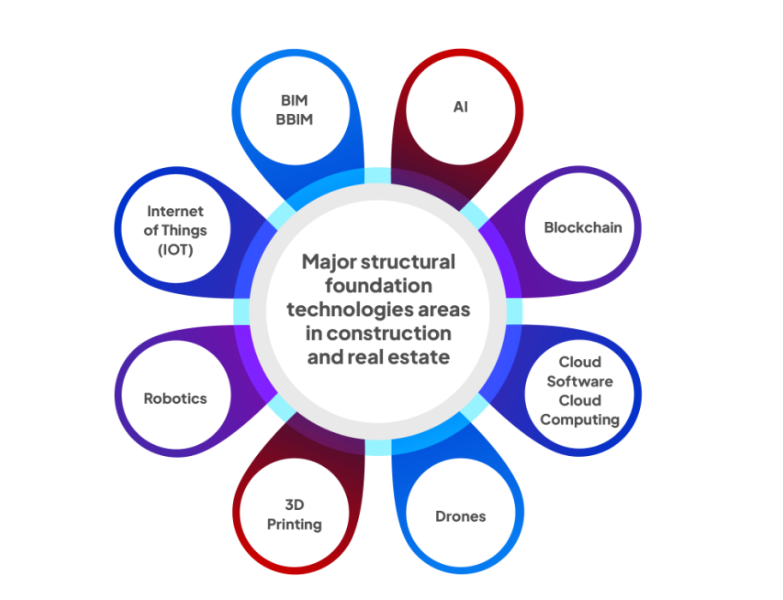 Major structural foundation technologies areas in construction and real estate, Infographic by Dinis Guarda
As of 2024, over 5.3 billion people, roughly 66% of the global population, use the internet. This widespread digital transformation has touched almost every aspect of life, from social well-being to education.
However, despite the internet’s massive impact on various industries, construction and real estate have faced significant hurdles in adopting these advancements.
The global real estate and property sector plays a crucial role in the global economy. It’s one of the largest industries worldwide, surpassing even the size of global equity and bond markets combined. In fact, real estate is nearly four times the size of global GDP.
This shows the vast influence real estate has, not just as a driver of economic growth but as a source of investment, housing, and essential infrastructure for businesses and public services.
Despite its central role in the global economy, the sector is undergoing rapid shifts, driven by megatrends like urbanisation, digital transformation, demographic changes, and increased demand for sustainable practices.
These trends are pushing the real estate and construction industries into a future where technology, transparency, and efficiency take centre stage.
Key challenges facing real estate and property development
While the real estate sector is massive and influential, it faces a number of challenges that hinder growth and development:
- Regulatory complexity and compliance: Real estate companies often operate across multiple regions, each with its own set of regulations, from zoning laws to environmental standards and building codes. The challenge of ensuring compliance across these different jurisdictions can lead to delays, fines, or legal disputes if not properly managed.
- Lack of transparency: Historically, the real estate sector has struggled with transparency, especially in emerging markets. The opaque nature of transactions can result in corruption, money laundering, and inefficiencies, reducing trust among stakeholders and impeding smooth transactions.
- Fragmented market data: The real estate industry generates a vast amount of data, but it’s often fragmented across various platforms, making it difficult for investors and developers to make informed decisions. Data on property valuations, market trends, and transaction histories can be inconsistent, which poses challenges for the efficient functioning of the market.
- Sustainability and environmental impact: Real estate contributes significantly to global energy consumption and greenhouse gas emissions. According to the World Economic Forum, buildings account for 33% of global energy use and 40% of greenhouse gas emissions. This growing environmental concern is pushing the industry to adopt greener technologies and sustainable development practices.
- Access to financing: In some regions, particularly developing economies, real estate developers face difficulties accessing financing. According to the International Monetary Fund (IMF), stringent financial regulations and risk-averse banking systems can make it challenging to secure capital for development projects.
The Rise of AI, Blockchain, and PropTech
The real estate and construction industries are undergoing a radical transformation, driven by technological advancements that promise greater efficiency, transparency, and sustainability.
Three key innovations, Artificial Intelligence (AI), Blockchain, and Property Technology (PropTech), are reshaping how properties are valued, transacted, and managed.
1. Artificial Intelligence: Smarter Market Analysis and Predictive Insights
Artificial Intelligence is no longer a futuristic concept, it’s actively revolutionising real estate by enhancing decision-making, automating valuations, and predicting market trends.
How AI is changing the game
- Automated Valuation Models (AVMs): Traditional property appraisals rely on manual inspections and comparables, which can be slow and subjective. AI-powered AVMs analyse historical sales data, market trends, and predictive algorithms to generate near-instant, highly accurate valuations. This reduces human error and speeds up transactions.
- Predictive Analytics for Investments: AI helps investors forecast rental yields, occupancy rates, and capital appreciation by processing vast datasets, economic indicators, population growth, and even local infrastructure developments. This allows for data-backed investment strategies rather than gut-feel decisions.
- AI-Powered Customer Service: Chatbots and virtual assistants now handle property inquiries, schedule viewings, and even negotiate terms, improving customer experience while reducing operational costs.
The opportunity
AI minimises human bias, accelerates transactions, and optimises portfolio management, giving firms a competitive edge in an increasingly data-driven market.
2. Blockchain: Transparency and Secure Transactions
Real estate has long suffered from opaque transactions, fraud risks, and inefficiencies, especially in cross-border deals. Blockchain technology is changing that by introducing unprecedented transparency and security.
How blockchain is disrupting real estate
- Smart Contracts: These self-executing digital contracts automate transactions (sales, leases, mortgages) when predefined conditions are met, eliminating intermediaries and reducing delays.
- Immutable Property Records: Blockchain creates a tamper-proof ledger of ownership history, reducing fraud and disputes. This is particularly valuable in emerging markets where land registry systems are unreliable.
- Tokenisation & Fractional Ownership: Blockchain enables property tokenisation, allowing investors to buy fractional shares in real estate. This democratises access to high-value assets, opening the market to smaller investors.
Real-world examples
- Propy: A blockchain platform enabling fully digital property transactions, from offer to closing.
- Dubai Land Department: Uses blockchain to streamline registrations and reduce fraudulent activities.
The opportunity
Blockchain reduces fraud, speeds up cross-border deals, and makes real estate investment more accessible, fostering a more liquid and transparent market.
3. PropTech: Smart Buildings and Sustainable Development
The demand for energy-efficient, sustainable buildings is growing, and PropTech is at the forefront of this shift. By integrating IoT, AI, and modular construction, the industry is becoming smarter and greener.
Key PropTech Innovations
- IoT-Enabled Smart Buildings: Sensors monitor energy consumption, air quality, and maintenance needs in real time, allowing for automated adjustments to lighting, heating, and cooling—cutting costs and carbon footprints.
- Modular & Prefabricated Construction: Off-site manufacturing of building components reduces waste, speeds up construction, and lowers costs, making projects more scalable and sustainable.
- AI-Driven Building Management: Smart systems predict equipment failures, optimise space usage, and enhance security, improving operational efficiency.
A leading example
Edge Technologies (Netherlands) designs AI-powered smart offices that dynamically adjust energy use, setting new standards for sustainable urban development.
The opportunity
PropTech lowers operational costs, attracts eco-conscious tenants, and helps developers comply with tightening environmental regulations, making it a must-adopt for future-proof real estate.
 AI-generated image showcasing Digital twin in construction, Infographic by Dinis Guarda
The future: A more efficient, transparent, and sustainable industry
The integration of AI, blockchain, and PropTech isn’t just about incremental improvements, it’s a complete overhaul of how real estate and construction operate.
- Faster transactions: Digital contracts and automated compliance cut processing times from weeks to hours.
- Lower costs: Reduced fraud, efficient resource allocation, and predictive maintenance save billions.
- Greater accessibility: Tokenisation and crowdfunding open real estate investment to a broader audience.
- Sustainability compliance: Smart buildings and green materials help meet global net-zero targets.
The World Bank, IMF, and OECD have all emphasised the need for digital transformation in real estate. The question is no longer if the industry will change, but how quickly businesses can adapt.
Embracing the Shift
The construction and real estate sectors are at a crossroads. The old ways, slow, opaque, and inefficient, are no longer sustainable.
The future belongs to those who leverage AI for smarter decisions, blockchain for trust, and PropTech for sustainability.
Change is difficult, but the rewards are immense: higher efficiency, lower risks, and a more resilient industry. The time to act is now, before the competition leaves you behind.
As Machiavelli warned, those who resist change will fight it, and those who stand to gain may hesitate. But in a world where digital transformation is inevitable, the real risk isn’t adopting new technologies, it’s ignoring them.
The foundation has been laid. The question is: Will you build on it?


