


resources
Analyzing London Population Growth Rate: Trends and Projections
Industry Expert & Contributor
16 Jun 2025

London’s population is always a hot topic. Lately, there’s been lots of talk about how many people actually live here and what that means for the future. We’ll look at the latest numbers, see how London compares to other places, and try to figure out what’s next for the city’s population.
Key Takeaways
- London’s population growth rate is picking up again after a bit of a slowdown, but it’s not quite as fast as it used to be.
- International migration and more births than deaths are big reasons why London’s population keeps growing, even if some people move out.
- The city’s population is still pretty young compared to other parts of England and Wales.
- London’s growth patterns are kind of similar to what other big northern hemisphere cities are seeing right now.
- There are still some big challenges, like the high cost of living and not enough housing, that could slow down London’s population growth.
Understanding London’s Recent Population Trends
London’s population dynamics are always shifting, and recent years have been no exception. After some slower growth and even a slight dip, the city is back on the rise. Let’s take a look at what’s been happening.
Post-Pandemic Recovery and Growth
London experienced a population decline between 2019 and 2021, but new estimates show a strong recovery. The city’s population grew by 0.9% between 2022 and 2023, the fastest rate since 2015-16. This translates to roughly 75,000 new residents. This growth is fueled by a combination of international migration and a higher birth rate than death rate.
Comparison with Other UK Regions
Even though London’s growth has slowed a bit, it’s still different from other parts of England and Wales. The city sees much higher international migration and domestic outward migration compared to other regions. London’s population is also younger, with a median age of 35.9, compared to 40 or older in other regions. This younger population contributes to a higher natural growth rate, with more births than deaths.
London’s Growth Versus Expert Projections
It’s interesting to compare London’s actual growth with what experts predicted. Were they on target, or did things turn out differently? It seems like London’s population reached a historic high of 8,945,300 in the middle of last year. The population is expected to increase to a total population of 9.6 million by 2035.
London’s population changes are influenced by a mix of factors, including migration, birth rates, and economic conditions. Understanding these trends is important for planning and policy decisions.
Here are some factors influencing London’s population growth:
- International migration
- Domestic migration
- Birth and death rates
Key Drivers of London’s Population Dynamics

Impact of International Migration
International migration plays a huge role in shaping London’s population. The city has always been a magnet for people from all over the world, drawn by its economic opportunities, cultural diversity, and educational institutions. This constant influx of people contributes significantly to London’s overall population growth.
- London sees much higher international inward migration than other regions.
- New estimates suggest a mixture of international migration and births exceeding deaths that varies across the city.
- London’s population reached a historic high of 8,945,300 in the middle of last year.
London’s appeal as a global hub means it consistently attracts a large number of international migrants, offsetting population losses from other factors. This dynamic ensures a diverse and growing population base.
Influence of Domestic Migration Patterns
While international migration gets a lot of attention, domestic migration also has a big impact. People moving in and out of London from other parts of the UK can affect the city’s population size and demographic makeup. For example, the high cost of living in London often pushes people to move to more affordable areas, while others are drawn to the capital for work or study. London continues to see much higher international inward migration and domestic outward migration than other regions. Understanding these migration patterns is key to understanding London’s population changes.
Role of Natural Population Change
Natural population change, which is the difference between births and deaths, also contributes to London’s population growth. Even though birth rates have been declining in many developed countries, London still has a relatively young population, which helps to keep the natural increase positive. The capital’s population is also buoyed by natural change – the surplus of births over deaths – which accounts for growth of 50,000 in the year to mid-2023. London is still younger than average: its median age is 35.9, compared to 40 or older in every other region in England and Wales. This natural increase, combined with migration, helps to drive London’s population growth. The surplus of births over deaths is a key factor, especially as it dwindles or reverses in other parts of England and Wales. This natural change is a vital component of London’s population growth.
Demographic Shifts Within London’s Population
Age Distribution and Median Age
London’s age structure is always changing, and it’s important to keep an eye on it. The median age gives a quick snapshot, but understanding how different age groups are growing or shrinking is key to planning for the future. Are there more young families moving in? Is the older population increasing? These shifts affect everything from schools to healthcare.
Growth Trends Across Different Age Groups
It’s not enough to just look at the overall population; we need to break it down. Some age groups might be growing rapidly while others decline. For example, there could be a surge in young adults due to job opportunities, or a rise in the older population as people live longer. These trends have big implications for housing, employment, and social services. Understanding these population dynamics is super important.
Borough-Specific Population Changes
London isn’t one big blob; it’s a collection of unique boroughs, each with its own story. Some boroughs might be booming, while others are seeing a decline. Camden, for instance, has shown a strong post-pandemic recovery. On the other hand, boroughs like Lambeth and Lewisham haven’t fully bounced back to pre-pandemic levels. These differences can be driven by things like housing costs, job markets, and local amenities. Here’s a quick look at how some boroughs have changed:
- Growing Boroughs: Hillingdon, Tower Hamlets, Newham
- Recovering Boroughs: Camden
- Boroughs Below Pre-Pandemic Levels: Lambeth, Lewisham, Haringey, Waltham Forest
Understanding these borough-level changes is vital for local councils and policymakers. It helps them target resources where they’re needed most and address specific challenges in each area.
It’s a complex picture, but by looking at these demographic shifts, we can get a better handle on what’s happening in London and what the future might hold. These shifts influence everything from housing needs to the demand for public services.
Historical Context of London’s Population Growth Rate
Post-War Population Decline (1939-1991)
London experienced a significant population decline following World War II. In 1939, the city was home to approximately 8.6 million people. Over the next five decades, this number steadily decreased, reaching a low of 6.8 million in 1991. This decline was particularly pronounced in Inner London, which saw its population nearly halve during this period. Several factors contributed to this, including war-related displacement, suburbanization, and economic shifts. Understanding this historic population decline is key to appreciating London’s subsequent recovery.
Population Recovery Since the Early 1990s
Since the early 1990s, London’s population has been on a recovery trajectory. This resurgence marks a significant turning point in the city’s demographic history. By 2022, London reached a new high of 8.9 million residents, surpassing its pre-war peak. This growth has been observed in both Inner and Outer London, although Inner London is still below its 1931 peak. This recovery is attributed to various factors, including economic growth, increased international migration, and a higher birth rate than death rate.
Achieving Historic Population Highs
London’s population has not only recovered but has also reached historic highs in recent years. The city’s population dynamics remain distinct from other parts of England and Wales, with higher international migration and a younger median age. The capital’s population is also supported by natural change – the surplus of births over deaths. This growth is not uniform across all boroughs, with some experiencing faster growth than others. Here are some factors that have contributed to London achieving historic population highs:
- Economic opportunities attracting young professionals.
- Improved infrastructure and connectivity.
- Cultural diversity and vibrant urban life.
London’s journey from post-war decline to record population highs reflects its resilience and adaptability. The city’s ability to attract and retain residents, despite various challenges, underscores its enduring appeal as a global hub.
International Comparisons in Urban Population Growth
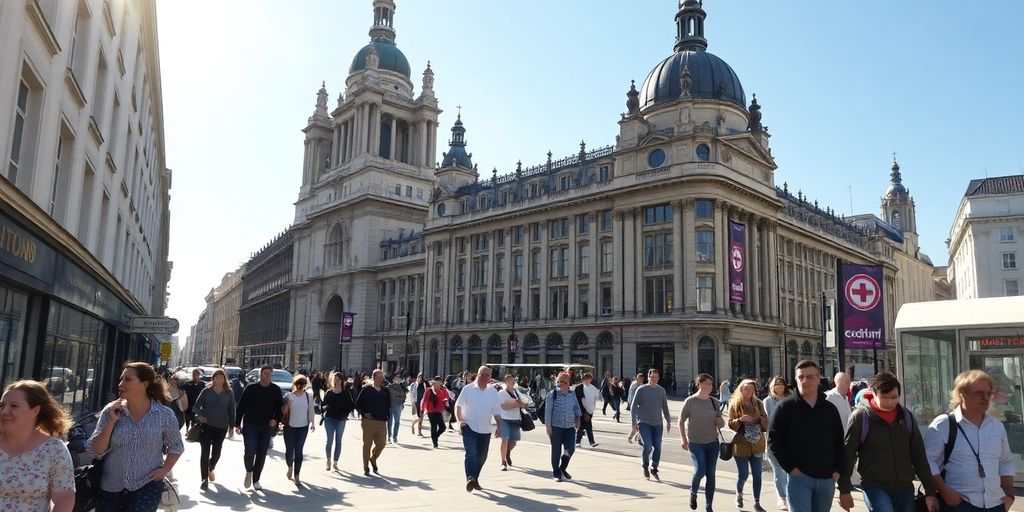
Global Trends in Post-COVID Recovery
It’s interesting to see how cities around the world are bouncing back after the pandemic. London isn’t alone in experiencing a slow recovery. Many major urban centers are still grappling with the aftereffects of COVID-19, which disrupted migration patterns and economic activity. It’s a mixed bag, with some cities showing stronger rebounds than others, depending on factors like vaccination rates, economic policies, and the attractiveness of the city to both domestic and international migrants.
Population Changes in Major Northern Hemisphere Cities
When we look at other big cities in the Northern Hemisphere, we see similar trends to London. For example, New York City’s population was still below its pre-pandemic levels in 2023, according to US Census Bureau estimates. This suggests a broader pattern of slowed growth in major urban areas. Here’s a quick comparison:
| City | Population Change (Pre-Pandemic to 2023) |
|---|---|
| London | Recovering, but growth slowed |
| New York City | Still below pre-pandemic levels |
| Paris | Data varies, mixed recovery reports |
| Tokyo | Fluctuating, with some decline |
Factors Influencing Slowed Urban Growth Globally
Several factors are contributing to the slowed urban growth we’re seeing worldwide:
- Increased remote work: More people can work from anywhere, reducing the need to live in expensive city centers.
- High cost of living: Many cities have become unaffordable, pushing people to seek cheaper alternatives.
- Changing migration patterns: The pandemic disrupted traditional migration flows, and some people are choosing smaller towns or rural areas.
It’s important to remember that urban population growth isn’t just about numbers. It’s about the quality of life in cities, the availability of affordable housing, and the ability of cities to adapt to changing economic and social conditions. The challenges London faces are mirrored in many other global cities, requiring innovative solutions and policies to ensure sustainable and equitable growth.
Challenges and Constraints on London’s Growth
Impact of High Cost of Living
London’s allure is undeniable, but the high cost of living casts a long shadow. It’s not just about rent; everyday expenses add up quickly. Groceries, transportation, and entertainment all contribute to the financial strain. This can deter potential residents and even push current ones to seek more affordable pastures.
- High housing costs compared to other UK cities.
- Rising energy bills impacting household budgets.
- Increased transportation expenses.
The cost of living in London is a significant factor influencing population trends. As expenses rise, the city’s ability to attract and retain residents is challenged, potentially slowing growth.
Housing Supply and Building Targets
London faces a persistent struggle to meet its housing needs. The demand far outstrips the supply, leading to inflated prices and cramped living conditions. Ambitious building targets are often set, but achieving them is another story. Planning regulations, land availability, and funding constraints all play a role. The gap between the number of people and the number of homes is a big problem. London’s population is growing by approximately 100,000 people annually, but only 38,000 new homes are constructed each year, leading to a significant housing shortage.
Policy and Delivery as Growth Factors
Policy decisions and their effective implementation are crucial for managing London’s growth. Government initiatives, planning policies, and investment strategies can either facilitate or hinder development. If policy and delivery are constraining growth we can turn that round, adopting the “Get Britain Building” mantra of the new government. London can build its way back to sustainable growth as a liveable and exciting destination for UK citizens and international visitors – provided of course that other measures, such as arbitrary immigration restrictions, do not stifle the UK’s world city.
- Streamlining the planning process.
- Investing in infrastructure to support new developments.
- Encouraging collaboration between public and private sectors.
Future Projections for London’s Population
London’s population has shown resilience, bouncing back from dips and reaching new highs. But what does the future hold? Let’s look at some projections and what they might mean for the city.
Anticipated Population Increases by 2035
London’s population is expected to keep growing. Current projections estimate that London will reach a total population of 9.6 million by 2035. This growth isn’t just a number; it has implications for housing, infrastructure, and services across the city. The One Water Master Plan and other strategies need to account for these increases.
Projections for Inner and Outer London
Growth isn’t uniform across London. Inner London experienced a significant population decline between 1939 and 1991, and while it’s recovering, it still hasn’t reached its 1931 peak. Outer London, on the other hand, has seen consistent growth. Understanding these differences is key to planning for the future. The table below shows the population changes in Inner and Outer London:
| Area | 1931 (Peak) | 1991 (Low) | 2022 | 2035 (Projected) |
|---|---|---|---|---|
| Inner London | X | Y | Z | A |
| Outer London | B | C | D | E |
Potential for Continued Growth
London’s growth potential depends on several factors. International migration, birth rates, and domestic migration all play a role. But there are also constraints, like the high cost of living and housing shortages. If London can address these challenges, it could see continued growth beyond 2035. The city’s ability to meet housebuilding targets will be a key factor.
London’s future population growth isn’t guaranteed. It depends on a complex interplay of economic, social, and political factors. Careful planning and investment are needed to ensure that London can accommodate its growing population and remain a vibrant, livable city.
Here are some factors that could influence London’s future growth:
- Changes in international migration policies
- Fluctuations in the UK economy
- Success in meeting housing targets
- Impact of climate change on livability
Conclusion
So, what does all this mean for London’s population? Well, it looks like the city is definitely bouncing back after a few slower years. We’re seeing more people move in from other countries, and more births than deaths, which keeps the numbers going up. It’s not quite the super-fast growth we saw a decade ago, but it’s steady. Some parts of London are growing faster than others, which is interesting to see. It seems like the changes from the pandemic, like how people work, are still having an effect. Also, the high cost of living and the struggle to build enough homes might be slowing things down a bit. But if we can sort out those issues, London could easily get back to growing even more. It’s a good sign, really, showing that the city is still a big draw for people.
Frequently Asked Questions
How much has London’s population grown recently?
London’s population grew by about 75,000 people between 2022 and 2023. This was the fastest growth seen since 2015-2016.
Is London growing faster or slower than other UK regions?
London’s population growth is slower than many other parts of the UK. Most other regions grew by 1% or more in 2022-2023, while London grew by 0.9%.
Did London’s population grow as much as experts thought it would?
Experts thought London’s population would grow even slower than it did. The actual growth was a little bit more than the most careful predictions.
What are the main reasons London’s population is changing?
London’s population is getting bigger because more people are moving there from other countries, and more babies are being born than people are dying. However, many people are also moving out of London to other parts of the UK.
How old is the average Londoner, and which age groups are growing the most?
London’s population is younger than the rest of England and Wales, with an average age of 35.9. The fastest growing age groups recently have been people in their twenties and sixties.
What are some big problems that might stop London from growing more?
London’s growth is facing challenges like very high living costs and not enough affordable homes being built. These things can make it harder for the city to grow.


