
resources
Master the 50 States and Capitals: Your Ultimate Guide
04 Feb 2026

Key Takeaways
- A plethora of engaging game modes, including shape quizzes, tap maps, capitals quizzes, flags quizzes, and neighbor quizzes, are available to facilitate your learning of the 50 states and their respective capitals.
- Proven memory techniques—such as the Method of Loci, or Memory Palace, and Mind Mapping—can be effectively employed to associate states and capitals with vivid visual cues, thereby significantly enhancing their recall.
- Flashcards, when strategically combined with active recall and spaced repetition, prove exceptionally effective for mastering the 50 states and capitals, consistently reinforcing memory over time.
- Leveraging a digital tool such as Flashrecall can streamline the learning process, automating spaced repetition and offering innovative features—like interactive 'chatting' with flashcards for supplementary assistance—to significantly boost efficiency.
- Deconstructing the learning journey into smaller, manageable segments—for instance, concentrating on a handful of states at a time and integrating both textual and visual elements—is crucial for preventing overwhelm and optimizing the retention of the 50 states and capitals.
1. The 50 States And Capitals
Indeed, let's turn our attention to the United States. It is, without a doubt, a vast nation, isn't it? Acquiring knowledge of all 50 states and their respective capitals can often seem like an insurmountable task—akin to, perhaps, attempting to count every grain of sand on a sprawling beach. Yet, here's a crucial insight: it's entirely achievable, and dare we say, genuinely enjoyable once you've truly grasped the methodology. Consider it a rewarding personal challenge, an enriching opportunity to deepen your understanding of this diverse nation.
Comprising 50 unique states, the nation boasts a distinct capital city for each. While some are exceedingly well-known—such as New York City (which, somewhat confusingly, is both a state and a prominent city, though its capital is Albany!) or Los Angeles (California's actual capital, incidentally, is Sacramento)—others may be smaller and less recognized, yet each plays an indispensable role in shaping the rich American tapestry.
To provide a foundational overview, let's briefly examine a selection of these:
- Alabama - Montgomery
- Alaska - Juneau
- Arizona - Phoenix
- Arkansas - Little Rock
- California - Sacramento
Indeed, internalizing all 50 states may appear formidable, but deconstructing the task renders it entirely manageable. It's akin to the adage of 'eating an elephant, one bite at a time'—though, one might hope, a significantly more palatable endeavor!
Throughout this guide, we'll explore a myriad of approaches to tackle this challenge, ranging from interactive games to sophisticated memory tricks, ensuring you discover the methodology best suited to your learning style. The objective, crucially, extends beyond mere rote memorization for an examination; it aims for genuine, lasting retention. Furthermore, achieving mastery of the states and capitals serves as an excellent foundation for expanding your general knowledge and, undoubtedly, impressing your acquaintances. Now, let's commence this enriching journey!
2. Campaign Mode: Your Journey Across America
Are you prepared to truly immerse yourself in the acquisition of states and their capitals? Campaign Mode, in particular, marks the genesis of a truly engaging adventure. Envision it as your personalized expedition across the United States, meticulously crafted to elevate your understanding from rudimentary U.S. geography to that of an absolute expert. This mode transcends mere factual memorization; it cultivates a profound connection with the nation, state by memorable state.
Your expedition commences within a designated region—perhaps the historic Northeast—and as you adeptly identify states and their capitals, you'll accrue valuable rewards, such as stars. These earned stars serve as your key to progressively unlocking subsequent segments of the map, guiding your advancement through diverse regions including the Midwest, the South, and ultimately, the West. It's an inherently structured pedagogical approach, carefully designed to prevent any sense of overwhelm. Indeed, with each increment of mastery, a larger portion of the interactive map illuminates, providing a compelling visual testament to your progress.
To offer a clearer understanding, let's examine its operational mechanics:
- Regional Progression: You'll systematically navigate the country region by region, incrementally building your knowledge base.
- Star-Based Unlocks: Accumulate stars upon successful completion of challenges, subsequently utilizing them to access novel areas on the map.
- Visual Progress Tracking: Observe your advancement unfold on a dynamic map, which eloquently visualizes your comprehensive learning journey.
- Percentage Trackers: Receive precise, numerical feedback detailing the extent of your geographical conquest.
This particular mode is meticulously designed to sustain your motivation. It expertly disaggregates the formidable endeavor of learning all 50 states into digestible segments, thereby transforming the process from a potential chore into an exhilarating exploration. You aren't merely engaging in study; you are, in essence, actively conquering geographical territory!
Ultimately, it's an exceptional method for witnessing the tangible expansion of your knowledge and for cultivating a profound sense of accomplishment as you steadily approach mastery of all 50 states.
3. 6 Exciting Game Modes
Acquiring knowledge of the 50 states and their capitals needn't be a monotonous memorization exercise. This guide, thoughtfully curated, features a diverse array of game modes, each engineered to render the learning process both engaging and highly effective. Each distinct mode addresses varying facets of geographical knowledge, thereby ensuring the development of a comprehensive and well-rounded understanding.
Permit us to introduce the six stimulating game modes available for your immediate engagement:
- Shape Quiz: This particular mode rigorously assesses your visual recognition capabilities. Can you accurately pinpoint a state solely by its distinctive outline? It's an excellent approach to hone your visual acuity for the unique geomorphic configurations of each state.
- Tap Map: In this interactive experience, your spatial awareness is truly challenged. You'll be tasked with locating and tapping the correct state on an interactive map of the United States. The ability to zoom in and out, naturally, significantly aids in achieving precision.
- Capitals Quiz: This classic mode, enduring for valid reasons, requires you to accurately pair each of the 50 states with its corresponding capital city. It's an ideal mechanism for cementing those crucial state-capital associations.
- Flags Quiz: Recognizing that every state possesses a distinct flag, this mode is designed to aid your identification skills. From the iconic Lone Star of Texas to California's Golden Bear, you'll undoubtedly evolve into a veritable flag connoisseur.
- Neighbors Quiz: This mode presents a robust challenge to your comprehension of state borders. You'll be required to identify states based on their contiguous counterparts—a genuine assessment of geographical interrelationships.
- True or False: Prepare for a rapid-fire assessment! You'll be prompted to swiftly ascertain the accuracy of statements concerning states, capitals, or regions. It's an expedient, fast-paced method for reinforcing factual knowledge.
Each distinct game mode is meticulously crafted to reinforce your learning in an engaging and highly interactive manner. By strategically alternating between these modes, you can sustain the freshness of your study sessions and precisely target areas that may require additional practice. Consider this akin to utilizing diverse training simulators to refine various proficiencies; indeed, such variety ensures sustained acuity.
These modes, it should be noted, transcend mere entertainment; they are inherently structured to facilitate active information recall, pattern identification, and the cultivation of genuine confidence. Whether you are a student diligently preparing for an examination or simply possessing an innate curiosity about American geography, these engaging games present a dynamic and effective pathway to mastery.
4. Dashboard & Statistics
Your educational journey, it must be emphasized, encompasses more than the mere memorization of facts; it truly revolves around visualizing the extent of your advancement. Our intuitive dashboard provides an unequivocal overview of your progress, ensuring you consistently understand your current standing and identify optimal areas for future focus. Consider it, if you will, your dedicated command center for achieving comprehensive mastery of the 50 states.
Within this centralized hub, you'll discover:
- Overall Progress: A concise display of your total mastery percentage across all states. Witness that figure ascend!
- Regional Breakdown: Delve more deeply into your performance, categorized by region—Northeast, Midwest, South, and West. This granular view assists in pinpointing specific areas that may necessitate additional attention.
- Key Metrics: Monitor essential statistics such as the cumulative number of questions answered, stars accumulated, and your current learning streaks. Consistency, after all, is paramount, isn't it?
- Performance Insights: This dedicated section delineates both the states and capitals you've mastered and those that continue to pose a slight challenge. Essentially, it serves as a personalized study guide, precisely indicating where to direct additional effort.
The dashboard, fundamentally, extends beyond mere numerical representation; it serves as a powerful catalyst for sustained motivation. The visual manifestation of your progress can profoundly influence your ability to remain engaged and steadfastly committed to the learning process.
We firmly contend that comprehending your individual learning patterns holds commensurate importance with the information itself. This granular perspective empowers you to study more strategically, rather than simply more assiduously, consequently rendering the process of mastering the states and capitals both more effective and, dare we suggest, genuinely enjoyable.
5. Study Center
Envision the Study Center as your indispensable, perpetually accessible reference library for all pertinent information concerning U.S. states and their capitals. It's meticulously designed to provide swift access to essential information, whether you're engaging in self-assessment or simply harboring curiosity about a specific state. You are welcome to navigate through all 50 states, examining their official flags and recognized abbreviations. Do you require knowledge of Delaware's capital or Montana's abbreviation? Rest assured, it's all meticulously compiled here, organized for effortless retrieval.
This dedicated section further encompasses crucial facts for each state, such as their capital cities and their respective geographical regions. It's an excellent starting point should you feel somewhat disoriented or wish to acquire a comprehensive overview prior to delving into more specialized learning methodologies.
The Study Center, unequivocally, stands as your primary resource for comprehensive factual information pertaining to all 50 states.
For clarity, here's a succinct outline of its contents:
- A complete list of all 50 states.
- Official state flags and abbreviations.
- Capital cities for each state.
- Regional information (Northeast, Midwest, South, West).
- Search functionality to quickly locate any state.
This valuable resource is expertly crafted to bolster your educational journey, furnishing the foundational knowledge essential for subsequent learning. It's not merely concerned with the rote memorization of names; rather, its purpose is to equip you with readily accessible facts, enabling you to forge meaningful connections and cultivate a robust comprehension of U.S. geography. For further insights into effective learning strategies, you might discover that resources akin to trading guides can prove instrumental in structuring your study habits efficiently.
Beyond its function as a mere compendium of facts, the Study Center actively facilitates your grasp of the broader geographical landscape. You are empowered to monitor your overarching progress and even ascertain your performance within particular regions. This analytical capability aids in identifying areas of proficiency and precisely pinpointing where additional focus might be beneficial. Ultimately, the aim is to optimize your study time for maximum effectiveness.
6. Customizable Settings
It's quite remarkable, isn't it, how the aesthetic and auditory presentation of an application can profoundly influence one's overall enjoyment and engagement? This is precisely where customizable settings prove invaluable. One might liken it to selecting a preferred ensemble before an outing—the desire for it to feel impeccably suitable is universal.
Crucially, you possess the autonomy to fine-tune various parameters to align with your personal study style. Perhaps you favor a darker screen for nocturnal study sessions, or conversely, you appreciate engaging sound effects to maintain an animated atmosphere. Alternatively, if susceptible to distraction, a silent mode might indeed be your most judicious choice. The overarching objective, therefore, is to render the learning process as comfortable and efficacious for you as can be achieved.
Consider these distinct avenues for tailoring your experience:
- Display Options: Select your preferred visual scheme, opting between a light or dark theme. Many users report that dark mode is more conducive to eye comfort, particularly during extended study periods or in low-light environments.
- Sound Preferences: Determine whether auditory effects should accompany quizzes and activities. These can be enabled for a more immersive experience or disabled for a tranquil study session.
- Reset Functionality: Should you wish to recommence your learning journey—perhaps to re-evaluate with a fresh perspective or to meticulously track progress from inception—an option to reset your data is typically available.
Implementing these seemingly minor adjustments can significantly contribute to sustained focus and heightened motivation. It's not merely a matter of assimilating states and capitals; it's profoundly about relishing the entire journey of acquisition. When the application genuinely feels collaborative, rather than adversarial, your propensity to remain engaged demonstrably increases.
Consider this analogous to configuring your personal workspace. You meticulously arrange your desk, optimize your lighting, and position your tools precisely to your preference. The identical principle holds true herein—personalizing the app's settings fosters an optimal environment conducive to mastering the 50 states and their capitals.
7. How To Memorize The U.S. States And Capitals: 3 Amazing Options
Acquiring knowledge of all 50 U.S. states and their capitals can certainly feel like a formidable undertaking, yet it is by no means predestined to be overwhelming. A multitude of effective methodologies exist, and discerning the most suitable one for your individual learning style can render the entire process significantly more enjoyable and fruitful. Consider this analogous to selecting a route for a cross-country journey—some individuals gravitate towards scenic byways, while others prioritize the most expedited highways. Presented below are three distinct approaches designed to assist you in mastering the intricate geography of the United States.
Option 1: The Memory Palace Technique
This time-honored memory technique entails constructing a mental map of a highly familiar location—such as your residence or a well-trodden route. Within this conceptual space, you subsequently position vivid images symbolizing the states and their capitals at distinct loci. For instance, one might visualize the state of California as a colossal golden bear (its official symbol) comfortably ensconced upon your living room sofa. Its capital, Sacramento, could then be depicted as a diminutive monarch perched atop the bear's head. As you embark on a mental promenade through your Memory Palace, encountering these deliberately placed images will invariably prompt your recollection of the state and its corresponding capital. The paramount principle here is to render these images as vivid, extraordinary, and even subtly whimsical as possible, thereby enhancing their memorability.
Option 2: Mind Mapping
Mind mapping, as a visual methodology for organizing information, can serve as an exceptionally beneficial tool when endeavoring to master all 50 states and their respective capitals. One commences with a central idea—in this particular application, the United States—and then systematically branches out to encompass related concepts. Consider creating an expansive circular map, positioning the United States at its core. Subsequently, you might delineate branches for broader regions (e.g., Northeast, South, Midwest, West), followed by tertiary branches for individual states. Upon each state branch, it is advisable to append its capital, a salient landmark, or even an apt mnemonic device. For example, when representing Texas, one might illustrate a cowboy hat and inscribe "Austin" adjacent to it. This methodology proves highly effective for discerning interconnections and comprehending the overall systemic integration of information.
Option 3: The Flashcard System with Active Recall
This represents a more traditional, yet demonstrably potent, methodology, particularly when executed with precision. Rather than passively absorbing information, flashcards compel active retrieval from your memory stores. One can construct cards featuring the state on one face and its capital on the reverse, or alternatively, utilize state outlines as prompts. The true efficacy, however, emanates from the strategic application of active recall—observing a state and endeavoring to recollect its capital without immediate recourse to the answer—and spaced repetition, which involves reviewing cards at progressively longer intervals just prior to anticipated forgetting. This consistent, deliberate retrieval process robustly fortifies neural memory pathways.
Regardless of the chosen method, the paramount consideration remains personal engagement. Transform the learning into a game, incorporate vibrant visuals, and do not hesitate to embrace creativity. The deeper your imaginative involvement, the more effortlessly you will recall the information at a later juncture.
For comparative purposes, an overview of these methodologies is provided below:
| Method | Strengths | Potential Challenges |
|---|---|---|
| Memory Palace | Highly visual, great for spatial memory | Requires imagination, can be complex |
| Mind Mapping | Shows connections, good for overview | Can get cluttered, less effective for detail |
| Flashcards (Active Recall) | Direct recall, proven effectiveness | Can be repetitive, requires discipline |
8. Learning States And Capitals Using the Method of Loci
The Method of Loci, frequently referred to as a 'memory palace,' constitutes an ancient mnemonic device for information retention. Its efficacy stems from leveraging deeply familiar environments—such as your personal residence—and strategically embedding the information you wish to recall into distinct locations within that mental construct. When recollection is desired, one simply undertakes a mental perambulation through the familiar space, 'observing' the previously placed items.
Regarding the memorization of U.S. states and their capitals, this technique is readily adaptable by transforming the physical map of the United States into your bespoke memory palace. Rather than employing a conventional architectural structure, you will utilize the distinct geographical features and overall layout of the nation as your mnemonic framework.
To commence the construction of your U.S. map memory palace, consider the following steps:
- Visualize the Map: Engage in a thorough observation of a United States map. Move beyond a cursory glance; meticulously discern its overall contours and unique attributes. What distinctive features capture your attention? Some individuals perceive a horse's head within the Great Lakes region, while others might notice boot spurs in Louisiana. Allow your imagination to freely roam, identifying these initial visual anchors.
- Use Major Features as Walls: Conceptualize the national borders, or prominent geographical features such as the Rocky Mountains or the Mississippi River, as the 'walls' or 'rooms' within your memory palace. The inherent shape of the country, in essence, becomes its architectural framework.
- Place States Strategically: Subsequently, begin the deliberate placement of states within this mental cartographic representation. This can be accomplished through several methods:
- Geographically: Position states according to their authentic locations on your mental map. For instance, envision California on the West Coast, Florida in the Southeast, and Maine in the Northeast.
- Ordered: Alternatively, you might mentally sequence states in a specific order—such as alphabetically or by population—and then situate them along a conceptual 'path' within your map-palace.
- Create Vivid Associations: For every state, cultivate a memorable, perhaps even eccentric, image that intrinsically links the state's name with its capital. For example, to recall Albany as New York's capital, you could visualize a colossal, undulating 'Al' (representing Albany) precariously balancing atop a 'Y' shaped to resemble the state of New York.
The fundamental principle dictates that these mental images should be rendered as exceptionally vivid and distinctive as possible. Indeed, the more distinctive the image, the more readily it will lend itself to recollection.
This innovative method effectively transmutes a two-dimensional map into a rich, three-dimensional mental construct, thereby significantly simplifying the navigation and recall of each state's location and pertinent associated information.
9. Memory Palace Technique
The Memory Palace, formally recognized as the Method of Loci, represents an ancient mnemonic stratagem for enhancing memory. Its operational principle involves utilizing highly familiar environments—such as one's residence or a frequently traversed route—and mentally embedding the information to be recalled into distinct points along that designated path. One might conceive of it as crafting a cognitive map wherein each discrete location safeguards a specific piece of information.
When recollection is desired, one simply undertakes a mental perambulation through their constructed 'palace,' thereby 'observing' the items previously situated within it. In the context of learning states and capitals, one may construct a distinct palace for each state, or alternatively, interconnect them into a larger conceptual structure. There's no imperative to adhere strictly to the geographical configuration of the U.S.; rather, you are encouraged to arrange your 'palace' in a manner that best resonates with your cognitive schema. Perhaps you envision a cherished park, where each bench or tree symbolically represents a particular state.
Here’s a fundamental methodological outline:
- Choose your palace: Select a location with which you possess profound familiarity, such as your home, your academic institution, or your daily commute route.
- Identify locations: Deconstruct your selected environment into discrete loci. For a residential setting, these could encompass the main entrance, the living room sofa, the kitchen table, and so forth.
- Place your items: Mentally position the state and its capital within each identified locus. For instance, at the main entrance, you might visualize a colossal Alabama flag, while upon the sofa, you perceive a diminutive Montgomery.
- Review: Embark on a mental perambulation through your constructed palace to robustly reinforce the established connections.
The critical element, indeed, is to render these mental images as exceptionally vivid and distinctive as possible. The more peculiar, humorous, or action-oriented the mental tableau, the more readily it will lend itself to subsequent recollection. For instance, if endeavoring to recall that Juneau serves as Alaska's capital, one might envision a colossal, cantankerous moose (representing Alaska) adorned with a minuscule crown and seated upon an imposing throne meticulously crafted from ice (symbolizing Juneau).
Furthermore, states can be arranged within your palace with a more structured approach—perhaps in columns or rows—to facilitate the visualization of their interrelationships or borders. This can prove particularly advantageous if your objective extends beyond merely memorizing states and capitals to encompassing their broader geographical context.
While this technique necessitates diligent practice, once mastered, it enables the recall of extensive information lists with remarkable precision. Indeed, it's akin to possessing a highly efficient, personalized filing system within your own cognition.
10. Mind Map Strategy
Mind mapping, an inherently visual methodology for information organization, can prove to be an exceptionally valuable tool when endeavoring to master all 50 states and their respective capitals. Consider it akin to constructing an expansive web, where each state functions as a primary branch, onto which a myriad of details can be affixed. This particular method actively facilitates the formation of cognitive connections that might otherwise remain undiscovered.
When constructing a mind map specifically for state memorization, endeavor to ensure that the chosen drawings or symbols actively trigger the desired answer. This approach is demonstrably superior to mere passive observation of the answer. It represents a potent form of active recall, a method considerably more efficacious for long-term retention than simple passive review.
Here’s a foundational approach to initiate your efforts:
- Start with a central idea: This foundational concept could be 'United States' or, indeed, simply a blank geographical outline.
- Branch out to states: From this central nexus, extend lines to represent each state. You might arrange these alphabetically, geographically, or perhaps even in reverse alphabetical order, offering a subtle mnemonic hint for sequential recall.
- Add details: To each branch, append capitals, popular nicknames, or even small illustrative drawings that symbolize an aspect of the state or its capital. For instance, in the case of Wisconsin, one might sketch a whiskey bottle. For Wyoming, a question mark could serve to prompt 'Why-o-ming?'
- Use color: Eschew a monochromatic palette. Alternating colors as you illustrate can provide a brief cognitive respite, facilitating the consolidation of information. It's akin to permitting your thoughts to subtly percolate in the background.
It is probable that you will require multiple mind maps to comprehensively cover all 50 states. The crucial aspect lies in the thoughtful organization of these maps. You always retain the flexibility to add capitals or other pertinent facts at a later stage—perhaps on adhesive notes or separate cards—thereby preventing undue clutter on your initial illustrations.
This integrated, visual approach can effectively transform the process of learning states and capitals from a perceived chore into an engaging creative project. It shrewdly capitalizes on the brain's innate mechanisms for information storage and retrieval, thus establishing itself as a formidable strategy for memorization.
11. Why State Flash Cards Work So Well
Flashcards represent an exceptionally robust methodology for assimilating knowledge of U.S. states and their capitals. Envision them as a mechanism for deconstructing a formidable, often daunting, task into smaller, highly manageable segments. Rather than attempting to internalize all information simultaneously, you are systematically concentrating on a single datum at any given moment. Consequently, this approach renders the entire learning process considerably less overwhelming.
The true efficacy of flashcards, however, originates from their strategic deployment alongside active recall and spaced repetition. Active recall, fundamentally, entails compelling your brain to retrieve an answer upon encountering a prompt, be it a state outline or a capital's designation—it is this slight cognitive effort that profoundly solidifies the information. Spaced repetition holds equal significance; it involves revisiting cards precisely before the anticipated onset of forgetting, as opposed to incessant, repetitive drilling. This strategic approach ensures you aren't expending valuable study time on already-mastered concepts.
For clarity, consider the distinct advantages they offer:
- Bite-Sized Learning: Each individual card concentrates on a singular fact or a paired set of facts (e.g., a state and its capital), thereby facilitating easier cognitive assimilation.
- Active Engagement: You are not merely engaging in passive reading; rather, you are actively endeavoring to retrieve information from your memory reserves.
- Targeted Review: You are empowered to swiftly identify states or capitals presenting challenges, enabling a concentrated allocation of your study efforts.
- Visual and Textual Cues: Flashcards can incorporate state outlines, recognized abbreviations, or even regional classifications, thereby accommodating diverse learning modalities.
Through the consistent utilization of flashcards, you are actively constructing a robust memory network. Every instance of accurate information recall invariably fortifies that particular neural connection in your brain. It's akin to the physiological process of muscle development—consistent repetition and concerted effort culminate in augmented strength.
While conventional paper flashcards can certainly prove effective, digital tools frequently elevate this methodology to a superior level. These digital platforms are capable of automatically shuffling cards, meticulously tracking your progress, and intelligently scheduling reviews, thereby rendering the entire process significantly more efficient and less susceptible to human oversight. This intelligent scheduling mechanism ensures that you are consistently reviewing precisely what is required, precisely when it is most beneficial for retention.
12. Step 1: Decide What You Actually Want To Learn About Each State
Prior to even contemplating the creation of flashcards or immersing yourself in any specific memorization technique, it's prudent to ascertain precisely what information you intend to associate with each individual state. Attempting to assimilate comprehensive data for all 50 states simultaneously can indeed prove overwhelming, hence a structured decomposition of the task is advisable.
Reflect carefully upon your primary objective. Is your intention solely to firmly establish the state-capital pairing? Or, does your requirement extend to knowing the state's official abbreviation, its geographical region (e.g., Northeast, Midwest, South, West), or perhaps its distinctive nickname? Conceivably, you might be aspiring for a more in-depth exploration, encompassing population figures, the year of statehood, or a pivotal historical fact.
For reference, here's an overview of common learning objectives:
- State Name <-> Capital City: This is the most basic pairing.
- State Name <-> Abbreviation: Useful for quick reference.
- State Name <-> Geographical Region: Helps place states in context.
- State Name <-> Nickname: Adds a bit of flavor and fun.
- State Name <-> Major City: Connects a state to its most well-known urban center.
- State Name <-> Population Range/Ranking: Gives a sense of scale.
- State Name <-> Year of Statehood: For historical context.
It is important to note that you are not obligated to assimilate all information instantaneously. Commence with foundational elements, such as the state and its capital, then progressively integrate additional details as your comfort level increases. You always retain the flexibility to generate new flashcards or append information at a subsequent point. The paramount principle involves establishing a distinct learning objective for each state prior to the construction of your study materials.
13. Step 2: Build State Flash Cards The Old Way… Or The Smart Way
Having ascertained your specific learning objectives for each state, the engaging phase of flashcard creation now commences. While one could opt for the conventional method of index cards, it's worth acknowledging their inherent susceptibility to misplacement, coupled with the onus of manual shuffling. Furthermore, they notably lack mechanisms to prompt timely study sessions.
The more astute approach, however, necessitates the utilization of tools that automate the process, thereby rendering your study efforts significantly more efficacious. Consider this reality: you are endeavoring to assimilate 50 states and their capitals, in addition to potential abbreviations, regional classifications, or even salient historical facts. This, undoubtedly, represents a substantial volume of information to retain accurately.
Presented below are several methodologies for constructing your flashcard deck, catering to both traditional preferences and those embracing the digital age:
- Text-Based Cards: This constitutes the standard format: "State Name" on one face, "Capital City" on the reverse. The cards can also be inverted—"Capital City" on one side, "State Name" on the other—a practice that facilitates bidirectional recall, proving exceptionally beneficial for examinations.
- Visual Cards: For individuals with a visual learning preference, this approach becomes particularly compelling. One can employ an image of a state's outline on one side, with the state name and capital presented on the reverse. Alternatively, highlight a state on a blank U.S. map and task the student with its identification. This method significantly enhances your ability to recognize states by their unique geomorphic shape and precise location.
- Information Integration: For a more comprehensive exploration, you are encouraged to design cards that incorporate additional details. For instance, one side might query the capital, abbreviation, and region of a state, with all corresponding answers provided on the reverse. Information can also be directly extracted from worksheets, textbooks, or even online video content, and subsequently transformed into effective study cards.
The objective isn't merely to accumulate a stack of cards; rather, it is to devise a systematic framework that facilitates efficient learning and retention. Leveraging appropriate technology can significantly streamline this process, thereby enabling you to dedicate more attention to the act of learning and less to the minutiae of manual organization.
14. Step 5: Use Active Recall Properly
Presuming your flashcards are prepared, perhaps even augmented by a sophisticated application, we now advance to the pivotal phase. This is the juncture where genuine assimilation of the material truly commences. Herein lies the critical role of active recall—a methodology that transcends the simple act of merely flipping a card and observing its solution.
The true cognitive transformation, it must be emphasized, occurs when your brain is compelled to exert a degree of effort in retrieving the correct response.
To execute this correctly, adhere to the following steps:
- Observe the prompt: This stimulus could manifest as a state name, a capital, or even a geographical outline. For instance, you might encounter "Capital of Oregon?
- Pause and engage cognitive retrieval: Refrain from immediately revealing the card's reverse. Allocate a brief moment. Endeavor to extract the answer from your memory. What is it—Salem, correct?
- Verify your answer: Subsequently, invert the card. Was your response accurate? If affirmative, excellent! If negative, that is entirely acceptable—it simply indicates areas warranting further concentration.
- Evaluate your recall: The majority of contemporary study applications will prompt you to assess the quality of your recollection. Be truthful! This feedback enables the system to intelligently determine optimal re-presentation intervals for that particular card.
This momentary pause—this subtle cognitive exertion employed to retrieve information—is precisely what forges more robust memories. Indeed, it's akin to a concise cerebral exercise.
Avoid the passive perusal of your flashcards. Actively compel yourself to retrieve the information. While it may initially present a slight challenge, rest assured, this practice yields a substantial disparity in both the volume and longevity of retained knowledge.
15. Step 6: If You’re Stuck On A State, Chat With It
Occasionally, despite repeated review, a specific state or its capital persistently resists retention. It's akin to attempting to grasp smoke—elusive and frustrating! Rather than succumbing to frustration, envision the possibility of directly querying the flashcard for assistance. With contemporary tools, such as the Flashrecall application, this imaginative scenario is, in fact, an attainable reality.
Should you consistently find yourself conflating, for instance, Kansas and Arkansas, or perhaps Nevada and Nebraska, resist the urge to merely continue flipping the card. Instead, access its detailed view and pose specific inquiries. You might request a mnemonic device to distinguish between them, or perhaps a concise explanation regarding its geographical placement relative to a state you've already mastered. The application can then furnish tailored memory aids, supplementary details, or contextual information that elucidates why a fact is so, rather than simply stating what it is. This innovative approach transforms the learning experience, shifting it from conventional rote memorization to a more engaging, interactive dialogue.
Consider these examples illustrating the application of this feature:
- Ask for a comparison: "What are the discernible differences between Vermont and New Hampshire on a map?"
- Request a memory aid: "Could you provide a whimsical mnemonic for recalling Montana's capital?"
- Seek geographical context: "Kindly specify Delaware's geographical relationship to Pennsylvania."
This inherently interactive approach effectively transmutes static information into a dynamic, responsive entity. It is fundamentally about accessing the precise assistance required, precisely at the moment of need, thereby enabling that resistant fact to finally coalesce in your understanding. Indeed, it's rather akin to having a patient, dedicated tutor perpetually available—24/7—prepared to elucidate concepts from novel perspectives until complete comprehension is achieved.
This methodology is highly commendable as it precisely targets your individual areas of difficulty. Rather than indiscriminately re-reading all material, you receive bespoke explanations that can prove pivotal in ultimately mastering those particularly challenging states.
16. Example: A Simple 10-State Starter Deck
Let us now transition to practical application. There is no necessity to attempt the assimilation of all 50 states and their capitals simultaneously. Such an endeavor often leads to cognitive fatigue. Instead, initiate your efforts incrementally. Consider it analogous to curating a playlist—songs are added progressively. An efficacious starting point would be a "starter deck" comprising approximately 10 states. This approach renders the entire process considerably more tractable.
Presented below is a sample list to facilitate your commencement:
- California
- Texas
- New York
- Florida
- Illinois
- Pennsylvania
- Ohio
- Georgia
- North Carolina
- Michigan
For each state within this initial selection, you will want to generate several distinct types of flashcards. This methodological diversity is pivotal for robustly embedding the information. Avoid adhering solely to a singular format. Consider implementing these approaches:
- State Name → Capital: This represents the most direct pairing. Front: "Capital of California?" Back: "Sacramento."
- Capital Name → State: Invert the prompt. Front: "Sacramento is the capital of which state?" Back: "California."
- State Name → Abbreviation: This format is valuable for rapid recognition. Front: "Abbreviation for Texas?" Back: "TX."
- State Outline → State Name: This is an excellent approach for visual learners. One can utilize an image depicting the state's geographical outline. Front: [Image of California's outline] Back: "California."
Commencing with a limited selection of states and employing diverse flashcard types significantly contributes to building confidence and fostering momentum. This is a considerably superior strategy compared to feeling overwhelmed by an extensive enumeration.
Upon achieving a comfortable level of proficiency with these initial 10 states, you may then augment your deck with another 10, systematically repeating the process. The art lies in sustained, gradual augmentation, allowing your chosen study tool (such as Flashrecall) to adeptly manage the review schedule. This intelligent approach ensures you aren't perpetually cramming, but instead, precisely reviewing the necessary information at its optimal recall interval.
17. Final Tips To Master All 50 States Without Losing Your Mind
Having explored a spectrum of methodologies—from intricate memory palaces to efficient flashcards—it's now opportune to synthesize these approaches comprehensively. Achieving mastery of all 50 states and their capitals is undeniably attainable, yet it hinges upon intelligent rather than merely arduous effort. Consider this analogous to acquiring any new skill—one wouldn't attempt to complete a marathon on the very first day, would one? Rather, proficiency is incrementally cultivated.
To ensure the learning process remains both fluid and effective, consider the following practical recommendations:
- Break it down: Eschew the attempt to internalize all 50 states simultaneously. Instead, target a manageable number daily—perhaps 5 to 10, contingent upon your individual pace. This strategy prevents a sense of overwhelm and facilitates optimal information absorption by your brain.
- Mix up your study materials: Diversify your study resources. If utilizing flashcards, consider integrating outline maps or even photographic representations of state landmarks. Visual aids, indeed, can profoundly aid in solidifying information. Analogously, when employing a mind map, endeavor to append a concise note about the capital adjacent to its respective state.
- Embrace active recall: This particular principle holds substantial weight. When engaging in self-quizzing, conscientiously endeavor to retrieve the answer from your memory prior to verification. That precise moment of cognitive exertion is where genuine learning actually transpires. Do not merely glance at the answer; rather, compel active deliberation.
- Let technology help with review: Rather than attempting to manually manage the review schedule for each state, permit a sophisticated spaced repetition system (such as that found in Flashrecall) to manage this task. It will intelligently present cards you are on the cusp of forgetting more frequently, and those you have mastered, less often. This approach is considerably more efficient than haphazard cramming.
The crux of success lies in unwavering consistency and discovering a personalized rhythm that optimally serves your learning style. It's not about sheer velocity, but rather about consistent, incremental advancement. Commemorate minor triumphs—such as mastering a new region or a particularly challenging capital—and you will discover that the entire process evolves into a significantly more enjoyable endeavor, far removed from any sense of tedious obligation.
Should you consistently encounter difficulty with a specific state or capital, resist the inclination to merely bypass it. Instead, endeavor to forge a distinctive associative link. Perchance the capital's name phonetically evokes an attribute related to the state's geographical form, or perhaps a significant historical connection exists. Indeed, on occasion, a modest creative association is the singular requirement for that particular piece of information to firmly embed itself in memory.
18. Learn United States Map Game
Engaging with a map-based game offers an exceptional pathway to familiarize oneself with the United States. It adeptly transforms the acquisition of geographical knowledge from a mundane chore into an engaging challenge or an intricate puzzle. One is not merely passively observing a static map; rather, active interaction is fostered, which profoundly aids in knowledge retention.
Such games frequently incorporate diverse modalities for assessing your knowledge. You might encounter a quiz necessitating the identification of a state solely by its geographical contour. This proves particularly beneficial for visual learners, as it compels recognition of the distinctive outlines of regions such as Florida or Colorado. Subsequently, the 'Tap Map' mode presents an interactive display of the entire nation, requiring you to click on the correct state when prompted. This mode, in particular, profoundly refines your capacity for rapid geographical pinpointing.
Beyond mere positional knowledge of states, many map games additionally evaluate your understanding of capitals, state flags, and even the contiguity of state borders. The 'Neighbors Quiz,' for example, serves as a truly stimulating cognitive exercise, prompting you to consider the geographical interconnections between states. It's quite astonishing how much insight can be gained simply by attempting to discern which states share common boundaries.
The principal advantage of these map games, it must be noted, lies in the active recall they assiduously encourage. Rather than passively reviewing a list, you are continuously prompted to retrieve information, which unequivocally constitutes a more effective methodology for forging enduring memories. Indeed, it's akin to self-assessment, albeit presented within an engaging, gamified interface.
Furthermore, a considerable number of these games incorporate a 'Campaign Mode' or an analogous progressive system. One might commence within a singular region, such as the Northeast, and be required to master those specific states prior to advancing to the Midwest, South, or West. With each successful endeavor, the map progressively illuminates, visually charting your advancement. It's a profoundly gratifying method for observing the extent of your national geographical 'conquest,' state by meticulous state. Additionally, the accumulation of stars or points for accurate responses provides a commendable incentive system that sustains motivation.
19. Shape Quiz
Have you ever observed a map and pondered, "Which particular state is represented by that distinct silhouette?" The Shape Quiz is meticulously engineered to assess precisely that capacity! It centers entirely on the recognition of the singular geographical contours of each U.S. state. Consider it akin to a jigsaw puzzle—however, instead of assembling individual components, your task is to identify the completed image.
This particular quiz mode offers an excellent avenue for cultivating robust geographical intuition.
Typically, its operation unfolds as follows:
- A state's geographical outline materializes on your screen.
- You will be presented with a selection of choices for the state's appellation.
- Select the accurate option to proceed.
While initially appearing straightforward, certain states exhibit remarkably analogous shapes, particularly when observed devoid of geographical context. This assessment compels meticulous attention to the nuanced distinctions in coastlines, borders, and overall geomorphic configurations. It's an engaging challenge that transcends the mere memorization of names and capitals, guiding you to genuinely perceive the map's intricate details.
20. Tap Map
This particular game mode is singularly focused on evaluating your proficiency in pinpointing geographical locations on a map. You will be presented with a map of the United States, and your designated task is to locate and tap on a specified state upon receiving its prompt. It's a direct, yet highly efficacious, method for familiarizing oneself with the precise spatial arrangement of each state.
The primary objective is straightforward: to accurately identify states on an interactive map. The functionality to zoom in and out is, moreover, exceptionally advantageous for discerning smaller states or for scrutinizing specific regions more closely. This mode rigorously assesses your visual recognition capabilities and spatial awareness of the nation's geography.
Generally, its operation proceeds as follows:
- A state's appellation or a visual prompt is presented.
- You then pinpoint that state on the U.S. map.
- Tap the accurately identified state to confirm your response.
- The game subsequently furnishes feedback regarding the correctness of your submission.
It's an excellent method for cultivating a robust mental representation of U.S. geography, transitioning beyond mere knowledge of names and capitals to a profound comprehension of the nation's physical configuration. You will begin to discern the interconnections between states and their relative positions, marking a significant advancement towards genuine map mastery.
21. Capitals Quiz
Indeed, let us now rigorously assess your knowledge of U.S. state capitals! This quiz mode is fundamentally designed to facilitate the accurate pairing of each capital city with its corresponding state. It's a time-honored classic for valid reasons—it profoundly aids in solidifying those crucial state-capital associations within your memory.
Conceive of it thus: you will encounter a state name, and your task will be to select its capital from a provided list; alternatively, you might see a capital and be required to identify its associated state. It's an uncomplicated, direct method for verifying your mastery of the capitals.
For illustrative purposes, here’s an overview of potential scenarios:
- State to Capital: You are presented with a state, such as "Oregon," and tasked with selecting its correct capital, "Salem."
- Capital to State: You are provided with a capital, for instance, "Austin," and must identify the corresponding state, "Texas."
- Multiple Choice: A state is displayed, and you are to select its correct capital from a series of provided options.
- Fill-in-the-Blank: You might encounter a state and be required to manually enter its capital.
This quiz proves exceptionally beneficial as it compels active information recall, moving beyond mere passive reading. It is, indeed, a pivotal component in ensuring the lasting retention of those capitals.
This quiz mode is meticulously designed to be both challenging and equitably administered. It aids in identifying any deficiencies within your capital knowledge, thereby enabling a more concentrated and efficacious allocation of your study efforts. Do not be concerned if a few answers elude you; this is an inherent aspect of the learning trajectory!
22. Flags Quiz

Are you prepared to rigorously test your visual memory? The Flags Quiz provides the ideal platform where you'll endeavor to match those distinctive state banners with their corresponding states. It's more than a mere display of appealing visuals; each flag frequently narrates a story or embodies a pivotal facet of the state's history or identity. Do you believe you can, at a mere glance, differentiate between the iconic Lone Star of Texas and the distinctive Bear Flag of California?
This mode is exceptionally effective for reinforcing your knowledge in an engaging, visual manner. You will be presented with a flag, and subsequently, your task will be to select its corresponding state from a given list of options. It's an excellent method for cultivating a robust mental image for each state, a skill that can prove immensely beneficial when attempting to geographically situate them or recall their capitals.
Generally, its functionality operates as follows:
- You will be presented with a specific state flag.
- You will then select the correct state from a provided set of multiple-choice answers.
- The quiz may also operate in a reverse capacity, displaying a state and prompting you to identify its flag.
Diligent observation of the intricate details within each flag can significantly enhance their memorability. Actively seek out recurring symbols, distinctive color palettes, and emblematic patterns that could establish an associative link to the state's appellation or historical narrative.
This quiz transcends the mere memorization of colors; its essence lies in associating a unique visual emblem with each state. It introduces an additional stratum to your learning, thereby rendering the information more adhesive and considerably more engaging than a simple perusal of lists.
23. Neighbors Quiz
This particular quiz mode thoroughly evaluates your comprehension of the geographical configuration of the United States. It's not solely concerned with identifying a state's name or capital; rather, it's about grasping its intrinsic position within the national tapestry.
You will be presented with a state and tasked with identifying which of its contiguous counterparts share a border. This offers an exceptional method for visualizing the nation and discerning the interconnections between states. It represents a significant progression beyond mere memorization of names and capitals, impelling you to contemplate intricate geographical relationships.
The utility of this quiz is multifaceted:
- Spatial Awareness: It cultivates a robust understanding of the relative positioning of states.
- Border Memorization: You will naturally commence the recall of which states share contiguous boundaries and which do not.
- Contextual Learning: It assists in situating states within broader geographical regions and comprehending the overarching geographical continuum.
This mode is especially valuable for comprehending regional disparities and how states might engage economically or culturally, influenced by their geographical proximity. It introduces an additional dimension of practical geography to your educational pursuit.
Consider it analogous to a 'connect-the-dots' exercise, albeit utilizing actual states. Upon encountering "Colorado," for example, you would be tasked with recalling its contiguous neighbors, such as New Mexico, Kansas, Nebraska, Wyoming, Utah, and Oklahoma. Accurate responses signify a profound comprehension of the map's intricate structural arrangement.
24. True or False
This particular game mode is fundamentally centered on rapid cognitive processing and impromptu knowledge assessment. You will be presented with declarative statements concerning U.S. states and their capitals, and your objective will be to determine their veracity. It's an expedited method for gauging the efficacy of your information retention.
For instance, you might encounter a statement such as: "The capital of California is Los Angeles." Your task is to promptly select 'True' or 'False.' In this specific scenario, the accurate response is 'False,' as Sacramento serves as the capital of California.
Below are some frequently encountered categories of statements:
- State and Capital Accuracy: Statements directly asserting the link between a state and its capital, e.g., "Juneau is the capital of Alaska." (True)
- Geographic Location: Assertions concerning a state's general placement, for instance, "Nevada is located in the Midwest." (False)
- Bordering States: Claims regarding contiguous states, such as "Colorado borders Texas." (False)
- State Nicknames or Facts: Declarations pertaining to established facts or popular nicknames, for example, "The Grand Canyon State is Arizona." (True)
This mode is highly effective for reinforcing facts you have previously assimilated. It assists in apprehending those subtle details that might otherwise elude detection during passive perusal.
It's an engaging challenge to ascertain how many consecutive correct responses you can achieve. Do not be perturbed if you miss a few; this merely highlights areas that could benefit from additional review. Consider it a rapid diagnostic assessment of your geographical acumen!
25. How To Remember The State Borders and more
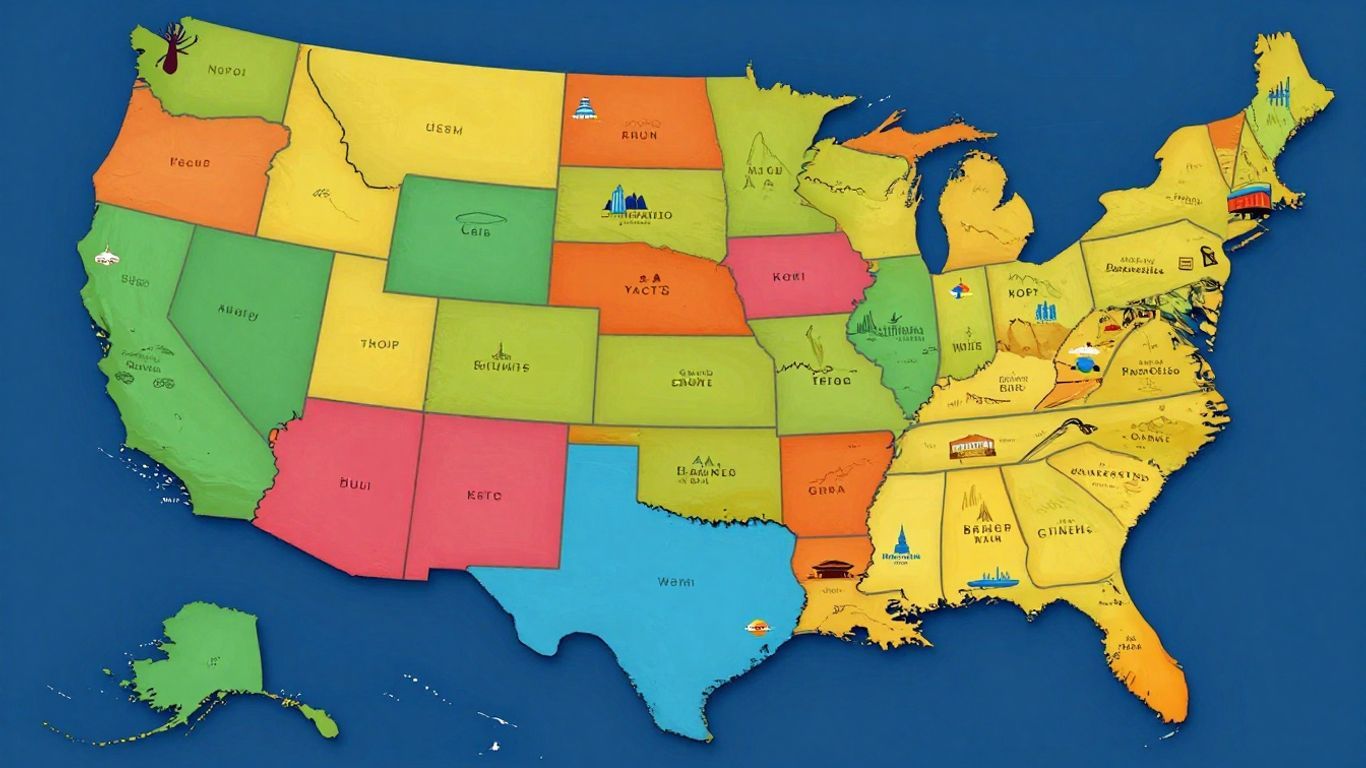
Recalling the intricate borders between U.S. states can indeed present as a complex puzzle; however, several ingenious mnemonic strategies exist to facilitate their retention. Consider the nation's overarching geographical form and the way individual states coalesce within it. Occasionally, the geomorphic configurations themselves provide valuable clues. For example, the Great Lakes region might visually evoke a horse's head, or Louisiana could appear to possess distinctive boot spurs.
Moreover, employing cardinal directions can prove to be profoundly beneficial. North, naturally, is oriented towards the top, south towards the bottom, and similarly for other directions. One can leverage these directional cues to construct mental columns or rows of states, thereby disaggregating the formidable task of memorizing all 50. Envision commencing with solely the northernmost states, utilizing their shared border as a conceptual 'wall' within your mental landscape.
Here’s a structured approach to consider:
- Visualize a Journey: Select an initial state and mentally project a journey to its contiguous neighbors. What would be the most direct route? Which prominent landmarks would you encounter en route?
- Connect with Stories: Devise concise narratives that forge links between adjacent states. For instance, to recall New Hampshire's border with Vermont, one might visualize a laundry hamper infested with vermin. The more whimsical the imagery, the more indelibly it will embed itself in memory.
- Use Mnemonics: Construct phrases or acronyms wherein the initial letter of each word corresponds to a state within a specific sequence or region. For example, for the New England states, one might craft a phrase that aids in recalling Maine, Vermont, New Hampshire, Massachusetts, Rhode Island, and Connecticut.
Occasionally, the most effective strategy for recalling borders involves contemplating inherent logical connections. One might ask, why would one state organically transition into another? Perhaps it's due to a shared river, a mountain range, or even a historically significant boundary. Cultivating these interconnections transforms the perception of the map from a haphazard assemblage of shapes into a cohesive, interconnected landscape.
Integrating capitals into this framework can be achieved by intricately weaving them into your state-specific narratives. If you are conceptualizing a journey, perhaps the capital city serves as a pivotal stop along that route. For instance, should you be recalling Washington state, you might envision George Washington employing Olympic rings as a defensive shield, thereby forging a memorable link between the state and its capital, Olympia.
Keep Exploring!
Thus, we present this comprehensive overview. While the endeavor of learning all 50 states and their capitals might initially appear formidable, with the appropriate methodology, it can indeed become quite enjoyable. Whether you opt for interactive games, advanced memory tricks such as the Method of Loci, or digital flashcards, the paramount factor remains discovering what resonates with you personally and adhering to that method consistently. Do not feel compelled to assimilate all information instantaneously. Deconstruct the task, practice consistently, and acknowledge your incremental advancements. The United States is an immense and captivating nation, and a thorough understanding of its geography offers an excellent means of forging a deeper connection with it. Maintain consistent practice, and you will swiftly evolve into a geography connoisseur!
Frequently Asked Questions
What is the best way to start learning the US states and their capitals?
One can effectively commence by concentrating on a smaller contingent of states, perhaps ten at a time. The utilization of flashcards, whether in physical or digital format, provides an excellent avenue for practice. Endeavor to create cards that prompt for the capital when given the state, and reciprocally. Additionally, self-assessment regarding state shapes can significantly aid in recalling their geographical placement on the map.
Are there any fun games or modes to help learn geography?
Absolutely! Numerous applications offer a diverse array of game modes, including shape quizzes, interactive map-tapping games, capitals challenges, and even flag identification exercises. Certain platforms feature a 'campaign mode' wherein users progressively advance through various regions, thereby transforming the learning experience into an engaging adventure of national conquest.
How can I remember the exact location of each state and its borders?
A robust visualization of the map is paramount. One can employ techniques such as the 'Method of Loci' or construct a 'Memory Palace,' within which states are associated with familiar locations or salient landmarks. Engaging in 'Neighbors Quiz' games, where the identification of states is based on their contiguous counterparts, similarly fortifies your comprehension of their borders.
What's the deal with 'active recall' and 'spaced repetition'?
Active recall refers to the deliberate attempt to retrieve an answer from memory prior to verifying it—for instance, endeavoring to name a capital before inverting a flashcard. Spaced repetition, conversely, involves revisiting information precisely before its anticipated decline from memory. Collectively, these strategies render studying significantly more efficacious than mere passive re-reading of notes.
Can I use technology to help me study states and capitals?
Undoubtedly! A plethora of applications are specifically engineered for this purpose. These frequently incorporate features such as instant flashcard generation from textual or image data, automated review scheduling, and even interactive chat functionalities for soliciting mnemonic devices or detailed explanations concerning particular states.
What if I get stuck on a particular state or capital?
Should you encounter persistent difficulty with a particular state, consider employing mnemonic devices or memory tricks. For instance, one might associate the state's appellation or geographical contour with a memorable concept. Certain advanced study tools even permit direct 'chat' interaction with a flashcard to receive immediate explanations or pertinent memory aids.
Share

citiesabc resources
Citiesabc is a digital transformation platform dedicated to empowering, guiding, and indexing cities worldwide. Established by a team of global industry leaders, academics, and experts, it offers innovative solutions, comprehensive lists, rankings, and connections for the world's top cities and their populations


