
resources
Smart Factory Industry 4.0: Driving Manufacturing Efficiency with IoT and AI
Industry Expert & Contributor
17 Jul 2025

Let me break down smart factory industry 4.0 in plain words. It’s all about hooking up machines with sensors and AI so you can spot issues fast and keep things humming. You’ll also see what tools run the show and how to get your team ready.
Key Takeaways
- It explains how smart factory industry 4.0 mixes physical gear, connected sensors, and AI to run things.
- You get a look at the core tech: IoT networks, basic machine learning, and robots doing the heavy lifting.
- It shows ways IoT and AI cut downtime with early maintenance alerts, quick quality checks, and flexible schedules.
- It covers how data maps help you watch operations live, use local or cloud power, and get suggestions to work smoother.
- It points out the need to train people, set up safe connections, and meet rules so everything works right.
Understanding Smart Factory Industry 4.0 Architecture
Smart factories are changing how things are made. They’re all about using tech to make manufacturing better, faster, and more efficient. But to really get how these factories work, you need to understand their basic structure. It’s like looking at the blueprint of a building before you start construction.
Cyber-Physical Systems Integration
Cyber-Physical Systems (CPS) are a big deal in smart factories. Think of them as the link between the digital world and the physical one. They make it possible for machines and systems to talk to each other and make decisions without needing people to step in all the time. This integration is what allows for real-time monitoring and control of manufacturing processes. It’s not just about connecting machines; it’s about creating a system where everything works together smoothly. For example, a sensor on a machine can detect a problem and automatically adjust the machine’s settings to prevent a breakdown. This kind of proactive approach is what makes smart factories so efficient.
Industrial IoT Connectivity Layers
The Industrial Internet of Things (IIoT) is the backbone of any smart factory. It’s the network that connects all the different devices and systems. This connectivity is organized in layers, each with its own job. You’ve got sensors collecting data, networks transmitting it, and platforms analyzing it. It’s like a well-organized communication system where information flows freely and securely. Without these connectivity layers, the whole smart factory concept falls apart. Think of it like this:
- Device Layer: Sensors and actuators collecting data from machines and processes.
- Network Layer: Wired and wireless networks transmitting data to central systems.
- Platform Layer: Software platforms analyzing data and providing insights.
AI-Enabled Process Orchestration
Artificial Intelligence (AI) is what takes smart factories to the next level. It’s not enough to just collect data; you need to be able to make sense of it and use it to improve your processes. AI algorithms can analyze data in real-time and make decisions that optimize production, reduce waste, and improve quality. This is what we call process orchestration. It’s like having a conductor who makes sure all the different parts of the orchestra are playing in harmony. AI can also predict problems before they happen, allowing for proactive maintenance and preventing costly downtime. It’s a game-changer for manufacturing.
Smart factory architecture isn’t just about technology; it’s about creating a system where everything works together seamlessly. It requires careful planning, integration, and a focus on continuous improvement. By understanding the different components and how they interact, manufacturers can unlock the full potential of Industry 4.0 and achieve new levels of efficiency and productivity.
Core Technologies Driving Manufacturing Efficiency
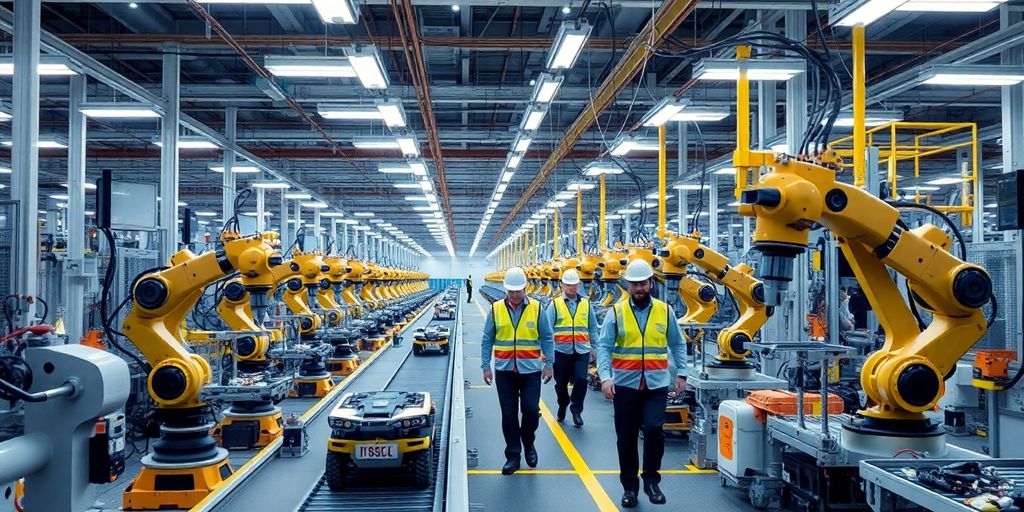
Industry 4.0 is changing how things are made, and it’s all thanks to some really cool tech. It’s not just about making things faster; it’s about making them smarter, more efficient, and more responsive to what customers want. Let’s take a look at the core technologies that are making this happen.
Industrial IoT Device Networks
The Industrial Internet of Things (IIoT) is the backbone of the smart factory. It’s a network of sensors, machines, and systems that all talk to each other. These devices generate tons of data, giving manufacturers real-time insights into their operations. Think of sensors on machines that track temperature, vibration, and performance. This data is then used to optimize processes, predict maintenance needs, and improve overall efficiency. The IIoT connects machines, systems, and sensors, enabling real-time data collection and communication.
Here’s a simple example of how IIoT can improve efficiency:
- Real-time monitoring of machine performance.
- Automated alerts for potential issues.
- Remote control and adjustments of equipment.
Machine Learning Applications
Machine learning (ML) is where things get really interesting. ML algorithms can analyze the massive amounts of data generated by IIoT devices to identify patterns, predict outcomes, and make decisions without human intervention. This means machines can learn from their mistakes and improve over time. For example, ML can be used to optimize production schedules, reduce waste, and improve product quality. Self-learning platforms are designed to streamline industrial processes, from production to predictive maintenance.
Machine learning is not just about automation; it’s about creating systems that can adapt and improve on their own. This leads to more efficient, resilient, and responsive manufacturing processes.
Advanced Robotics and Automation
Robotics has been around for a while, but advanced robotics takes it to the next level. We’re talking about robots that can work alongside humans, adapt to changing conditions, and perform complex tasks with precision and speed. These robots are equipped with sensors, AI, and machine learning algorithms that allow them to see, think, and react to their environment. This leads to increased productivity, reduced labor costs, and improved safety. These technologies enable machines to learn from data, adapt to new conditions, and make informed decisions without human intervention.
Here’s a quick look at how advanced robotics is used:
| Application | Description the content is:
Enhancing Operational Efficiency with IoT and AI
Smart factories are all about doing things better, faster, and cheaper. A big part of that comes from using the Industrial IoT and AI to streamline operations. It’s not just about automating tasks; it’s about making smarter decisions based on real-time data.
Predictive Maintenance Workflows
Imagine knowing when a machine is about to break down before it actually happens. That’s the power of predictive maintenance. By using sensors to monitor things like temperature, vibration, and energy use, and then feeding that data into AI algorithms, manufacturers can predict potential equipment failures. This allows them to schedule repairs proactively, minimizing downtime and maximizing production efficiency.
Think of it like this:
- Sensors collect data on machine performance.
- AI algorithms analyze the data to identify patterns.
- Maintenance teams are alerted to potential issues.
- Repairs are scheduled before breakdowns occur.
This approach not only saves money on repairs but also prevents costly disruptions to the production schedule.
Automated Quality Inspection
Quality control is crucial in manufacturing, but manual inspections can be slow and prone to errors. AI-powered vision systems can inspect products for defects with much greater speed and accuracy. These systems learn from each inspection, becoming increasingly accurate at identifying flaws. This reduces the need for manual quality control and ensures that products meet the required standards.
Automated quality inspection isn’t just about finding defects; it’s about preventing them in the first place. By identifying patterns and trends in the data, manufacturers can adjust their processes to eliminate the root causes of defects.
Smart Production Scheduling
AI can also optimize production schedules based on real-time demand and supply chain data. By analyzing historical data and current trends, AI algorithms can forecast future demand, allowing manufacturers to adjust production plans accordingly. This helps avoid overproduction or stockouts, improving inventory management and cost savings. It’s about getting the right products to the right place at the right time.
Here’s a simple example of how AI can improve production scheduling:
| Scenario | Traditional Scheduling | AI-Powered Scheduling | Outcome |
|---|---|---|---|
| Demand Surge | Overproduction | Adjusted Production | Reduced waste, met actual demand |
| Supply Chain Delay | Production Halt | Shifted Production | Maintained output, minimized disruption |
Data Analytics and Intelligent Decision Making
Data is the lifeblood of any smart factory. It’s not just about collecting information; it’s about turning that raw data into actionable insights that drive better decisions. Think of it as moving from simply knowing what’s happening to understanding why it’s happening, and then predicting what will happen next. This section explores how data analytics and AI are used to make manufacturing smarter, faster, and more efficient.
Real-Time Data Visualization
Imagine a control room where you can see every aspect of your factory floor in real-time. That’s the power of real-time data visualization. Instead of relying on static reports that are already outdated by the time you see them, you get a dynamic view of key performance indicators (KPIs), machine status, production rates, and more. This allows for immediate identification of bottlenecks, anomalies, or potential problems. Effective visualization transforms complex data sets into easily understandable formats, enabling quick responses to changing conditions.
Think of it like this:
- A dashboard showing the current output of each production line.
- Color-coded alerts highlighting machines that are running outside of their optimal parameters.
- Interactive charts that allow you to drill down into specific data points to understand the root cause of an issue.
Edge Versus Cloud Computing
Where you process your data matters. Edge computing brings the processing power closer to the source of the data – the factory floor. Cloud computing, on the other hand, offers massive scalability and centralized data storage. The choice between edge and cloud, or a hybrid approach, depends on factors like latency requirements, data security concerns, and the type of analysis you’re performing. For example, integrating IT and OT might require edge computing for immediate control actions, while long-term trend analysis could be handled in the cloud.
Consider these points:
- Edge Computing: Low latency, ideal for real-time control and immediate responses. Processes data locally, reducing reliance on network connectivity.
- Cloud Computing: High scalability, cost-effective for large-scale data storage and complex analysis. Centralized data management and accessibility.
- Hybrid Approach: Combines the benefits of both edge and cloud, allowing for flexible and optimized data processing.
Prescriptive Analytics for Optimization
Prescriptive analytics takes data analysis a step further by not only predicting what will happen but also recommending the best course of action. It uses AI and machine learning to identify optimal settings, schedules, and processes that maximize efficiency, minimize waste, and improve overall performance. It’s like having an AI consultant constantly analyzing your operations and suggesting improvements.
Prescriptive analytics is about more than just identifying problems; it’s about providing solutions. It helps manufacturers make proactive decisions based on data-driven insights, leading to significant improvements in productivity, quality, and profitability.
Here’s a simple example:
| Scenario | Predictive Analytics | Prescriptive Analytics |
|---|---|---|
| Machine Overheating | Predicts when a machine is likely to overheat. | Recommends adjusting the machine’s settings, scheduling maintenance, or reducing the workload to prevent overheating. |
| Production Bottleneck | Identifies a bottleneck in the production line. | Suggests reallocating resources, optimizing the workflow, or adjusting the production schedule to eliminate the bottleneck. |
| Quality Control Issues | Predicts when a batch of products is likely to fail quality control. | Recommends adjusting the manufacturing process, changing the materials used, or retraining the operators to improve quality. |
Building a Skilled Workforce for Digital Manufacturing
The move to smart factories and Industry 4.0 isn’t just about tech; it’s hugely about people. We need workers who can handle the new tech, analyze data, and work alongside robots. It’s a big shift, and it means investing in training and creating a culture of continuous learning. The integration of Quality Management is key to ensuring that the workforce is well-prepared and effective in the digital manufacturing environment.
Workforce Upskilling Programs
Upskilling is no longer optional; it’s a must. Companies need to create programs that teach employees the skills they need for the future. This includes things like:
- Data analytics: Understanding and interpreting the data that smart factories generate.
- IoT and sensor technology: Knowing how these devices work and how to troubleshoot them.
- Robotics and automation: Operating and maintaining automated systems.
- Cybersecurity: Protecting the factory’s systems from cyber threats.
These programs can take many forms, from online courses to hands-on workshops. The key is to make them accessible and relevant to the employees’ roles. A well-designed upskilling program can significantly improve employee engagement and productivity. It’s also important to consider offering certifications to validate new skills and provide career advancement opportunities.
Human–Machine Collaborative Practices
It’s not about robots replacing humans; it’s about humans and robots working together. This requires a shift in how we think about work. Instead of humans doing repetitive tasks, they can focus on more creative and strategic activities. To make this work, we need to:
- Design workspaces that are safe and efficient for both humans and robots.
- Develop interfaces that are easy for humans to use and understand.
- Train employees on how to work with robots safely and effectively.
The goal is to create a collaborative environment where humans and machines complement each other’s strengths. This means leveraging the precision and speed of robots while capitalizing on human problem-solving and critical thinking skills.
Change Management Strategies
Implementing Industry 4.0 can be disruptive. People may be resistant to change, especially if they’re worried about losing their jobs. That’s why change management is so important. Here are some things to keep in mind:
- Communicate clearly and often about the benefits of Industry 4.0.
- Involve employees in the planning and implementation process.
- Provide support and training to help employees adapt to new roles and responsibilities.
| Strategy | Description
By focusing on these three areas, manufacturers can build a workforce that is ready for the challenges and opportunities of Industry 4.0. It’s an investment that will pay off in increased efficiency, productivity, and innovation.
Ensuring Cybersecurity and Compliance in Smart Factories
Okay, so you’ve got all this cool tech running your smart factory. Awesome! But let’s be real, all those connected devices and data streams? They’re basically a giant welcome mat for cyberattacks if you don’t lock things down. And it’s not just about hackers; there are regulations to follow, too. Think of it like this: you wouldn’t drive a car without insurance and a license, right? Same deal here. Let’s talk about keeping your smart factory safe and compliant.
Securing Industrial IoT Endpoints
Think of every sensor, every robot, every connected widget as a potential entry point for trouble. You need to make sure each one is secure. It’s like having a bunch of doors to your house – you wouldn’t leave any unlocked, would you? Here’s what you should be doing:
- Strong Passwords: Obvious, but still needs saying. No more "password123"! Use complex, unique passwords for every device. And change them regularly.
- Regular Updates: Keep the firmware and software on all your devices up to date. Updates often include security patches that fix vulnerabilities.
- Network Segmentation: Divide your network into smaller, isolated segments. That way, if one device gets compromised, the attacker can’t just waltz into the rest of your system. Think of it as firewalls within your factory network.
- Device Authentication: Implement strong authentication methods, like multi-factor authentication (MFA), to verify the identity of devices connecting to your network.
AI-Driven Threat Detection
Trying to manually monitor all that data for threats? Good luck with that. It’s like trying to find a needle in a haystack the size of Texas. That’s where AI comes in. AI-powered threat detection systems can learn what "normal" behavior looks like on your network and then flag anything that seems suspicious. It’s like having a super-smart security guard who never sleeps. These systems can:
- Analyze Network Traffic: Identify unusual patterns that might indicate an attack.
- Monitor Device Behavior: Detect if a device is acting strangely, like sending data to an unknown location.
- Automate Incident Response: Automatically isolate compromised devices or block malicious traffic.
Cybersecurity isn’t a one-time thing; it’s an ongoing process. You need to constantly monitor your systems, update your defenses, and train your employees to be aware of potential threats.
Regulatory Standards and Best Practices
It’s not just about keeping the bad guys out; you also need to comply with industry regulations and standards. Depending on what you’re manufacturing, you might need to meet requirements like cyber-physical systems standards. These regulations are there for a reason – to protect sensitive data, ensure product quality, and maintain safety. Here’s a quick rundown:
- Know the Rules: Figure out which regulations apply to your industry and your specific operations.
- Implement Controls: Put in place the necessary security controls to meet those requirements. This might include things like data encryption, access controls, and audit trails.
- Get Certified: Consider getting certified to a relevant standard, like ISO 27001. This shows your customers and partners that you take security seriously.
| Standard | Description
Exploring Smart Factory Industry 4.0 Use Cases
Smart factories aren’t just a concept; they’re actively transforming industries. Let’s explore some real-world examples of how IoT and AI are being used to create more efficient, responsive, and innovative manufacturing processes. These use cases demonstrate the tangible benefits of Industry 4.0.
Automotive Production Optimization
In the automotive industry, smart factories are revolutionizing how cars are made. Think about it: every step, from stamping metal to installing electronics, can be optimized with data. For example, real-time monitoring of equipment performance allows for predictive maintenance, minimizing downtime and keeping production lines running smoothly. AI algorithms can analyze production data to identify bottlenecks and suggest improvements to workflow. This leads to faster production times, reduced waste, and higher quality vehicles.
Electronics Assembly Streamlining
The electronics industry is known for its fast pace and complex assembly processes. Smart factories are helping companies keep up by using IoT sensors to track components, monitor equipment, and ensure quality at every stage. Machine learning algorithms can analyze data from these sensors to identify defects early on, reducing scrap and improving yields. Advanced robotics can automate repetitive tasks, freeing up human workers to focus on more complex and creative work.
Pharmaceutical Quality Enhancement
Quality control is paramount in the pharmaceutical industry. Smart factories are using IoT and AI to ensure that every pill, injection, and cream meets the highest standards. Sensors monitor temperature, humidity, and other environmental factors throughout the production process. AI algorithms analyze data from these sensors to detect anomalies and prevent contamination. This leads to safer, more effective medicines for patients.
Consumer Goods Personalization
Consumers today want products that are tailored to their individual needs and preferences. Smart factories are making mass customization a reality by using IoT and AI to personalize products on the fly. For example, a clothing manufacturer could use data from a customer’s online profile to create a shirt that fits perfectly. A food company could use data from a customer’s health tracker to create a snack that meets their specific nutritional needs. This level of personalization was once a dream, but now it’s becoming a reality thanks to Industry 4.0.
Smart factories are not just about technology; they’re about people. By empowering workers with data and tools, companies can create a more engaged, productive, and innovative workforce. This is the key to unlocking the full potential of Industry 4.0.
Future Trends in Smart Factory Innovation
Smart factories are constantly evolving, and it’s exciting to think about what’s coming next. We’re not just talking about incremental improvements; some of these trends could fundamentally change how manufacturing works. The integration of cutting-edge technologies promises to redefine efficiency, sustainability, and customization in manufacturing.
Next-Generation Sensor Technologies
Sensors are the eyes and ears of a smart factory, and they’re getting a whole lot smarter. We’re moving beyond basic temperature and pressure sensors to devices that can analyze chemical compositions, detect microscopic flaws, and even predict material fatigue. These advanced sensors generate massive amounts of data, which can be used to fine-tune processes and improve product quality. Think of sensors that can "smell" when food is starting to spoil during production, or that can detect the tiniest cracks in an airplane wing before they become a problem. The possibilities are pretty wild. These sensors will need robust industrial IoT device networks to handle the data flow.
Quantum Computing Prospects
Quantum computing is still in its early stages, but it has the potential to revolutionize manufacturing. Imagine being able to simulate entire production lines to optimize them before even building them, or designing new materials with properties we can only dream of today. Quantum computers could also be used to solve incredibly complex scheduling problems, leading to huge efficiency gains. It’s a long way off, but the potential is there. It’s like having a super-powered brain that can solve problems that are impossible for today’s computers.
Sustainable Manufacturing Solutions
Sustainability is no longer a nice-to-have; it’s a must-have. Smart factories can play a big role in reducing waste, conserving energy, and minimizing environmental impact. This includes things like:
- Optimizing energy consumption using AI.
- Reducing waste through predictive maintenance workflows.
- Using closed-loop systems to recycle materials.
- Tracking the carbon footprint of every product.
Smart factories are becoming increasingly focused on sustainability. This involves not only reducing their own environmental impact but also developing products and processes that are more sustainable overall. This shift is driven by consumer demand, regulatory pressure, and a growing awareness of the importance of environmental stewardship.
It’s about making manufacturing not just efficient, but also responsible. The goal is to create a circular economy where resources are used and reused, minimizing waste and pollution. This also means attracting and retaining talent, as many workers want to be part of organizations that prioritize sustainability. The adoption of AI and machine learning is critical for achieving these sustainability goals.
## Conclusion
Smart factories put sensors on every machine so teams can catch small problems before they turn into big breakdowns. This cuts downtime and keeps the line moving. The data from those sensors goes into simple AI tools that tip you off when a part needs a check or when to tweak settings. The result can be less waste, better quality, and even higher output. That said, it’s not a plug-and-play fix. You still need to pick the right tech, train staff, and tweak the process over time. But once the system is humming, the plant runs with fewer surprises and lower costs. Going this route might look like a big step, but the boost in efficiency and savings makes it worth the push.
Frequently Asked Questions
What is a smart factory?
A smart factory uses connected machines and sensors to gather data and make decisions in real time. It blends Internet of Things (IoT) devices and AI to run more smoothly and save time.
How do IoT sensors improve manufacturing?
IoT sensors collect live data on temperature, vibration, and more so managers can spot problems early and keep machines running longer.
How does AI help make factories more efficient?
AI looks at data from sensors to predict when machines might break, tests products for flaws with cameras, and plans the best production steps to finish orders faster.
What is predictive maintenance?
Predictive maintenance uses data and AI to forecast equipment issues before they happen. This cuts down on unplanned repair stops and keeps production moving.
Why use edge computing instead of cloud computing?
Edge computing processes data right where it is made, so decisions happen faster and machines react instantly. It also lowers costs by sending less data over the internet.
How can workers learn digital skills for smart factories?
Workers can join training programs on IoT, AI, and data analysis to handle new tools. Hands-on workshops and online courses help them feel confident with smart factory tech.


