
Cities, first_page
The Dawn of Urban Humanity

How humanity’s first cities, Çatalhöyük, Uruk, and Babylon, revolutionised society, trade, and governance. These ancient urban experiments laid the foundation for commerce, law, and infrastructure, shaping the business world we know today.
 The Dawn of Urban Humanity
“The city is not a concrete jungle, it is a human zoo where man, the most predatory animal, has learned to live in peace with his own kind.” — Lewis Mumford
For nearly 200,000 years, our ancestors lived in harmony with nature, moving with the seasons, hunting, gathering, and following the natural rhythms of life. They were nomadic, and their existence was defined by cycles of movement, seeking food, shelter, and resources.
However, around 10,000 to 12,000 years ago, something remarkable happened: humans made a deliberate choice to stop wandering and to settle. This was no ordinary shift. It was, in fact, the very genesis of urban life as we know it today.
This decision to “stay put” sparked the development of agriculture, and with agriculture came the birth of architecture, social structures, and civilization. It was a profound change in how we lived, how we thought about our place in the world, and how we began to shape the world around us.
For the first time, people were not just surviving, they were beginning to build.
And what a gamble it turned out to be.
Read More:
The Agricultural Revolution
 Agricultural Revolution
Before cities, there was surplus. Before the surplus, there was agriculture.
The transition to settled life didn’t happen overnight, of course. It was sparked by something much simpler than grand designs or elaborate plans, it began with the simple observation of nature.
In the Fertile Crescent, a region that stretches across modern-day Iraq, Syria, and Turkey, some early humans began to notice that wild plants, like wheat and barley, grew near their campsites. In time, they figured out how to nurture and grow these plants deliberately, creating the very first crops.
This was the beginning of what historians call the Neolithic Revolution.
Agriculture allowed for surplus food production, people could now grow more than they needed to survive, and this surplus was a game changer. With surplus came the opportunity for specialization. Some people could focus on farming, while others could pursue other crafts like pottery, tool-making, and weaving.
This marked the first steps toward the birth of cities.
The Neolithic Revolution, the transition from foraging to farming occurred independently in at least seven regions worldwide:
- The Fertile Crescent (wheat, barley)
- China (rice, millet)
- Mesoamerica (maize, beans)
- The Andes (potatoes, quinoa)
- Eastern North America (sunflower, squash)
- Sub-Saharan Africa (sorghum, yams)
- New Guinea (taro, bananas)
Why did we start farming?
Contrary to popular belief, farming wasn’t an immediate improvement over hunting and gathering. Early agriculture was back-breaking work, with less varied diets and higher disease risks. So why bother?
- Climate Change: The end of the last Ice Age (around 12,000 years ago) stabilised weather patterns, making cultivation feasible.
- Population Pressure: As hunter-gatherer bands grew, wild resources became scarce. Farming allowed controlled food production.
- Sedentary Experimentation: Some groups, like those at Abu Hureyra (Syria), began storing wild grains, accidentally domesticating them over generations.
Çatalhöyük: The First Urban Experiment (7500-5700 BCE)
 Çatalhöyük (7500-5700 BCE), Image: Wikipedia
One of the most fascinating sites from this early period of human history is Çatalhöyük in what is now Turkey. It wasn’t just a village; it was humanity’s first real experiment in dense, permanent settlement.
Imagine houses clustered so closely together that people entered their homes through the roofs, walking across their neighbours’ homes like tightrope walkers on a high wire.
At its peak, this site housed between 3,000 and 8,000 people, an impressive feat considering the time period. What’s so striking about Çatalhöyük is the apparent egalitarianism of its society.
There were no palaces, no temples towering over the city, and no clear markers of a wealthy elite. Instead, people lived in homes that were all roughly the same size and were often built on top of one another, with each home serving as both a residence and a place to bury the dead.
Yes, the dead were buried beneath the floors, symbolising the deeply ingrained connection between life, death, and the continuity of human existence.
The art found in these homes, paintings of animals, goddesses, and humans, tells us that the people of Çatalhöyük had a rich symbolic life. They were more than just survivors; they were dreamers, thinkers, and creators, laying the groundwork for urban society to come.
Why Did Çatalhöyük Decline?
Possible reasons:
- Environmental degradation (overuse of timber, soil exhaustion)
- Social tensions from overcrowding
- Migration to newer settlements
It wasn’t a city in the modern sense, but it was the first time humans chose to live together permanently.
The Mesopotamian Crucible: Where Cities Learned to Govern
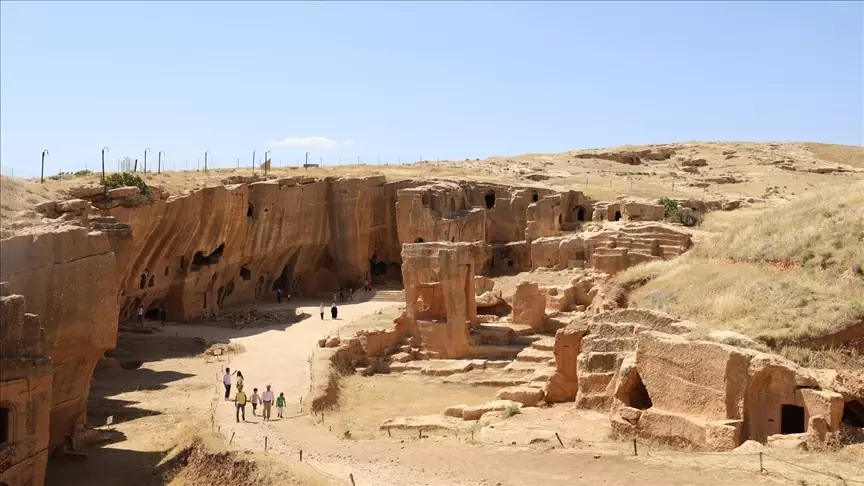 Mesopotamia, Image: Hurriyet Daily News
As the agricultural revolution spread to other parts of the world, the fertile river valleys of Mesopotamia became one of the most crucial places in human history.
This area, known as the “Cradle of Civilization,” is where some of the first true cities began to take shape. The challenges posed by the rivers, the need for irrigation, flood control, and resource management, led to the birth of city-states that were incredibly complex and sophisticated.
Uruk: The First True City (c. 4000-3100 BCE)
 Uruk (c. 4000-3100 BCE), Image: Archaia Creations
One of the earliest and most famous cities to emerge from this area was Uruk. Located in southern Mesopotamia, Uruk became humanity’s first urban powerhouse. This city was monumental, not just in size but in significance.
At its peak, Uruk housed as many as 50,000 people, more than many modern towns! It was here that writing was invented, a tool to record transactions, keep track of grain, and ensure the smooth running of the city.
But Uruk wasn’t just a centre of commerce. It was a place where humanity’s ambition reached new heights. The Anu Ziggurat, a massive stepped pyramid, symbolised the ambition of the city’s inhabitants to build something that reached towards the heavens. This was humanity’s first skyscraper, built not just to protect the city but to express the power and influence of its people.
Ur: The Merchant’s Dream (c. 3800-400 BCE)
 Ur (c. 3800-400 BCE), Image: World History Encyclopedia
Just south of Uruk, Ur rose to prominence. Unlike Uruk, whose wealth came from agriculture, Ur became rich through trade, connecting the Mediterranean and the Indus Valley.
Its position at the intersection of trade routes allowed it to thrive and grow into one of the most important commercial centres of the ancient world.
When archaeologist Leonard Woolley excavated Ur in the 1920s, he uncovered incredible wealth, golden helmets, silver vessels, and intricate jewellery. These artefacts painted a picture of a sophisticated society with a high standard of living and advanced urban planning.
The city had residential areas for the elite, craftsmen’s quarters, and a complex system of streets and drains, making it one of the first examples of urban zoning.
Babylon: The Imperial Vision (c. 1894-539 BCE)
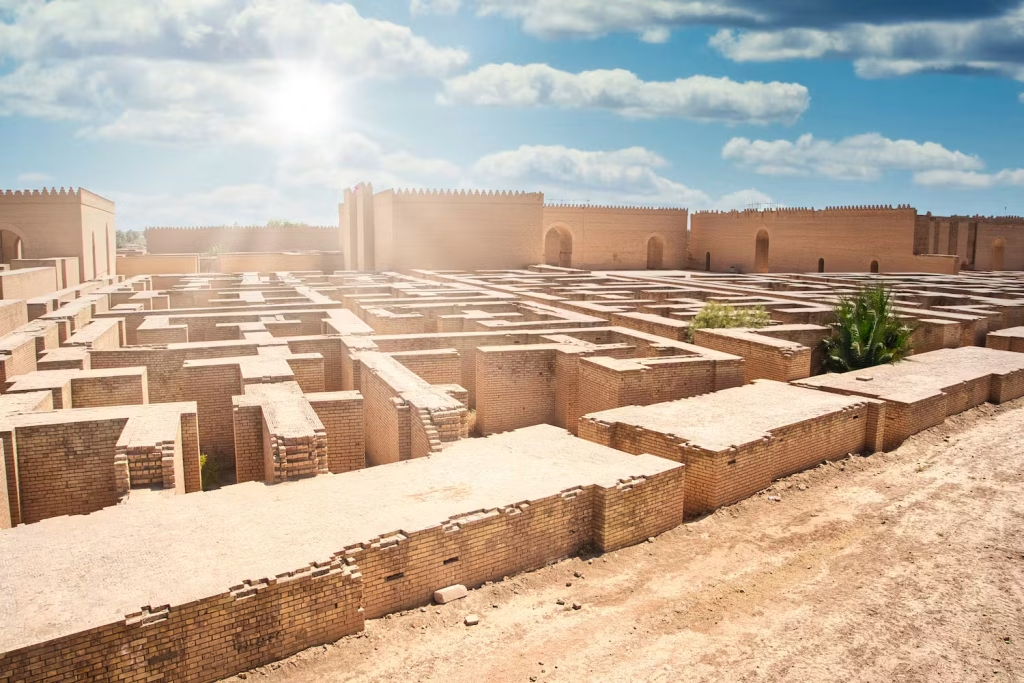 Babylon (c. 1894-539 BCE), Image: World Monuments Fund
By the time Babylon rose to prominence, urban life had evolved to include monumental architecture and imperial ambition. Under King Hammurabi, Babylon became a true imperial city, renowned for its size and wealth.
Hammurabi’s Code, one of the first written legal codes in history, set the foundation for law and governance that would shape future civilizations.
The Neo-Babylonian Renaissance
But it was under Nebuchadnezzar II that Babylon truly reached its zenith. The city became one of the Seven Wonders of the Ancient World, thanks in part to the construction of the Hanging Gardens of Babylon (whether or not they ever existed remains a mystery).
The Ishtar Gate, with its glazed brick depictions of lions and bulls, welcomed visitors into a city that seemed to stretch endlessly, its walls and gates symbols of Babylon’s grandeur.
The Indus Valley Enigma: Cities of the Unknown Civilisation
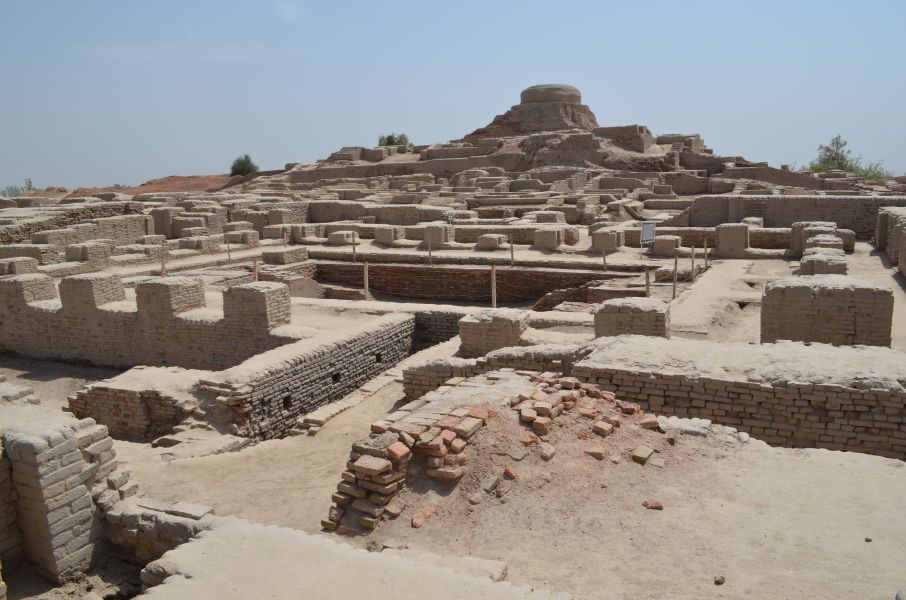 Image: World History Encyclopedia
Meanwhile, far to the east in the Indus Valley, another sophisticated civilisation was developing. Harappa and Mohenjo-daro were remarkable cities with a level of urban planning that rivaled their Mesopotamian counterparts.
The streets were laid out in neat grids, and sophisticated drainage systems revealed an advanced understanding of sanitation. Yet, despite these incredible achievements, the Indus script has yet to be deciphered, leaving us with a tantalizing mystery about the people who built these cities.
Harappa: The Orderly City (c. 2600-1900 BCE)
Harappa’s urban planning was ahead of its time, with its streets aligned to the cardinal directions, houses arranged in a grid pattern, and a highly advanced water management system.
But unlike the cities of Mesopotamia, there were no grand temples or palaces to showcase the power of rulers. The absence of monumental architecture suggests a different kind of society, possibly one that was more egalitarian or whose leadership was expressed in other ways.
Mohenjo-daro: The Great Bath Civilisation (c. 2500-1900 BCE)
Mohenjo-daro, with its famous Great Bath, is perhaps the most iconic structure of the Indus Valley. This sophisticated bathhouse suggests that the people of Mohenjo-daro had a deep understanding of hygiene and public infrastructure.
Despite its impressive design, the city was abandoned mysteriously around 1900 BCE, leaving behind a wealth of unanswered questions about what happened to this advanced civilisation.
Literary Echo: Gilgamesh and the Urban Soul
If we are to truly understand the impact of cities on human nature, we must turn to the world’s first urban narrative: the Epic of Gilgamesh. This ancient story, composed around 2100 BCE, is not just about a king’s adventures, it’s a profound exploration of what it means to live in a city, to balance individual desires with the needs of the community, and to grapple with the existential questions that arise when people come together in such close quarters.
Gilgamesh’s city, Uruk, stands as both a physical and philosophical symbol of what cities represent. His walls, symbols of human achievement and ambition are both protective and limiting. They encapsulate the tension that every city dweller feels: the desire for freedom versus the necessity of order, the balance between the individual and the collective.
The Anthropological Significance: What Cities Made Us
The decision to settle down, to build cities, reshaped human beings in ways we’re still grappling with today. Living in cities pushed us to develop new cognitive abilities, new forms of social organisation, and new technologies.
Urban life created the first true hierarchies, and it pushed us to think not just about the here and now, but about the future. In many ways, cities invented the concept of time itself, linear and divisible, marking a shift from the cyclical rhythms of nature to the structured time of urban living.
But it’s not all about the past. The legacy of these ancient cities is visible in our modern world. Every city we build, every community we form, is an echo of those first brave steps taken thousands of years ago.
The cities of the past have made us who we are today, and they continue to shape the cities of tomorrow.


